Key Takeaways:
- Dual-LMS Adoption Rising: Google Classroom often paired with Canvas or Schoology.
- Functionality Drives Strategy: Districts mix tools to cover missing features.
- Privacy Lawsuits Surge: Legal actions highlight student data concerns.
As K–12 schools increasingly rely on digital platforms like Google Classroom, Canvas, and Schoology, usage data reveals a clear trend: strategic dual-LMS adoption is on the rise. However, alongside this growing reliance on EdTech tools, a parallel story is unfolding—one marked by legal scrutiny. In the second part of this post, we shift focus to the lawsuits that are putting major EdTech providers under the privacy spotlight, raising critical questions about how student data is handled and what this could mean for the future of digital learning.
📊 What the Data Shows
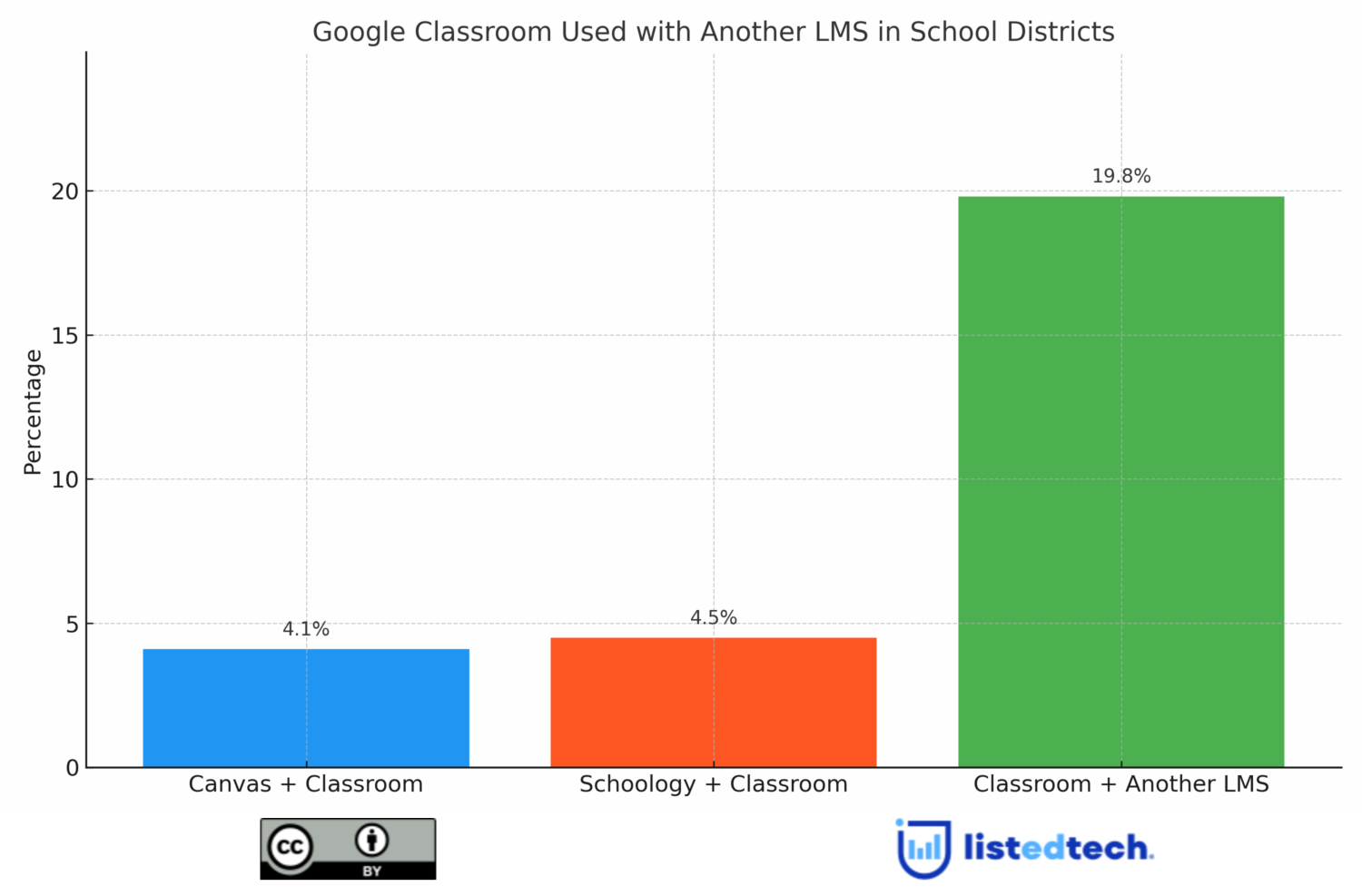
As K–12 school districts continue refining their digital learning strategies, a surprising trend has emerged from the data: nearly 20% of districts using Google Classroom are also using another major learning management system (LMS), such as Canvas or Schoology.
Our recent analysis of 7,865 school districts across the U.S. and Canada reveals:
- Canvas + Classroom usage in 4.1% of districts
- Schoology + Classroom usage in 4.5% of districts
- Total Google Classroom + Another LMS usage in 19.8% of districts
This makes the Google Classroom ecosystem particularly unique in its reliance on complementary platforms.
What’s Behind the Dual-LMS Adoption Trend?
This 1-in-5 figure points to more than just transitional tech rollouts. In many cases, we believe it signals a deliberate dual-system strategy:
- Split usage by level or campus: Elementary schools using Classroom while high schools adopt Canvas or Schoology.
- Transition in progress: Districts phasing into (or out of) a new LMS.
- Functional gaps: Google Classroom excels in day-to-day teacher-student interactions, but lacks some of the gradebook, SIS integration, or assessment tools required by many districts—especially larger ones.
Strategic, Not Temporary
Rather than being a short-term measure, the data suggests that many districts are intentionally combining platforms—using Google Classroom for simpler streamlined instructional delivery and a second LMS for more comprehensive features and customization options.
Why It Matters for Vendors and District Leaders
This dual-use pattern has several implications:
- For vendors: If you’re building integrations, tools, or services for K–12, it’s important to recognize the growing need for products that work across two systems.
- For district IT and curriculum leads: Understanding this trend can help guide long-term platform planning, professional development, and budgeting.
EdTech Under Fire: Lawsuits Raise Questions About Student Data Privacy
As education technology becomes more embedded in classrooms, a growing number of parents and advocates are questioning how companies handle student data. While learning management systems (LMS) have become a staple in today’s classrooms, their increasing presence brings concerns over data privacy. Recent lawsuits targeting major EdTech providers (including Google and PowerSchool) highlight the tension between innovation and student protection. These legal actions allege improper handling of student data and could have lasting implications for how educational tools are deployed and regulated.
Google: Tracking Students in the Classroom?
A federal lawsuit filed by California parents accuses Google of embedding hidden trackers within its Workspace for Education products. The claim? Google allegedly uses cookies and digital fingerprinting to monitor students’ online activity—even outside of classroom use.
Google’s position:
Google denies the allegations and maintains that it does not serve ads or use personal data for advertising in Workspace for Education. The company emphasizes that it provides strong privacy controls and that schools are responsible for obtaining parental consent under laws like FERPA and COPPA.
Read more on GovTech
PowerSchool: Monetizing Sensitive Student Records?
A federal judge recently allowed a lawsuit against PowerSchool to proceed. The case claims that PowerSchool collects extensive student data—ranging from disciplinary records to medical device usage—and shares it with third-party vendors for profit.
PowerSchool’s position:
PowerSchool strongly denies the allegations, stating that it complies with all applicable privacy laws and only shares data with third parties when authorized by the school district. The company emphasizes that its tools are designed to support educators and improve student outcomes—not to exploit data for commercial gain.
Read more on Patch
Why This Matters
These lawsuits highlight a fundamental tension in EdTech: how to deliver powerful tools to educators while respecting student privacy. While companies assert that their data practices comply with existing laws, parents and advocacy groups are increasingly calling for more transparency, clearer consent protocols, and limits on data retention and third-party access.
Bridging Dual-LMS Adoption and Accountability in K–12 EdTech
As districts continue to embrace the dual-LMS adoption to meet evolving instructional and administrative needs, it’s clear that flexibility and functionality are driving adoption. But this rapid integration of digital tools also brings heightened expectations around transparency, compliance, and ethical data use. The dual realities of rising LMS usage and increased legal scrutiny remind us that EdTech’s future depends not only on innovation, but also on accountability. For school leaders, vendors, and policymakers alike, balancing operational efficiency with student privacy will be key to building lasting trust in the digital classroom.
Editor’s note: We previously mentioned a legal complaint involving Instructure in an earlier version of this post. As the case was dismissed, we have removed that discussion and updated the article accordingly.