
Key Takeaways
- Security and Infrastructure Lead the Floor Plan: Security, Professional Services, Cloud, Hardware, and Network are among the largest 2026 exhibitor categories, reflecting continued investment in modernization, resilience, and institutional infrastructure.
- AI as Cross-Functional Layer: In addition to the specific category, AI is identified by more than 20 exhibitors across the floor as a core feature for their products.
- The Agenda and Exhibitor Floor Tell a Similar Story: Exhibitor counts and agenda-topic counts have moved in the same direction since 2021, particularly in Security, Cloud, ERP, LMS, Productivity, Help Desk, Data, and AI.
Each year, EDUCAUSE brings together HigherEd institutions, technology providers, consultants, and industry partners to discuss the challenges shaping campus technology. This technology forum provides a lot of information on the next big thing in EdTech by the presence/representations of EdTech vendors and consultants.
Since 2021, ListEdTech has tracked the evolution of the EDUCAUSE exhibitor floor. Our earlier analyses focused primarily on the largest exhibitors, using booth size as a proxy for market maturity and influence. In 2025, we expand our analysis to include every exhibitor, regardless of booth size. This broader view captures not only established market leaders, but also smaller companies and emerging categories that may signal change earlier.
This year, we are adding a second source of information: the conference agenda. The exhibitor floor shows the solutions and categories vendors bring to market. The agenda shows the topics, challenges, and conversations receiving attention from the higher-education community. This approach raises a new question:
Does the composition of the EDUCAUSE Commons align with the themes represented in the conference agenda?
Our preliminary analysis suggests that it does, but it should not be interpreted as evidence that exhibitors determine the agenda, or that the agenda determines the exhibitor floor. However, the two views generally point in the same direction.
The 2026 EDUCAUSE Commons
The 2026 exhibition hall dataset contains 319 exhibitors, the largest number of exhibitors since the pandemic. Below is a representation of the total exhibition footprint by category, between 2021 and 2026.
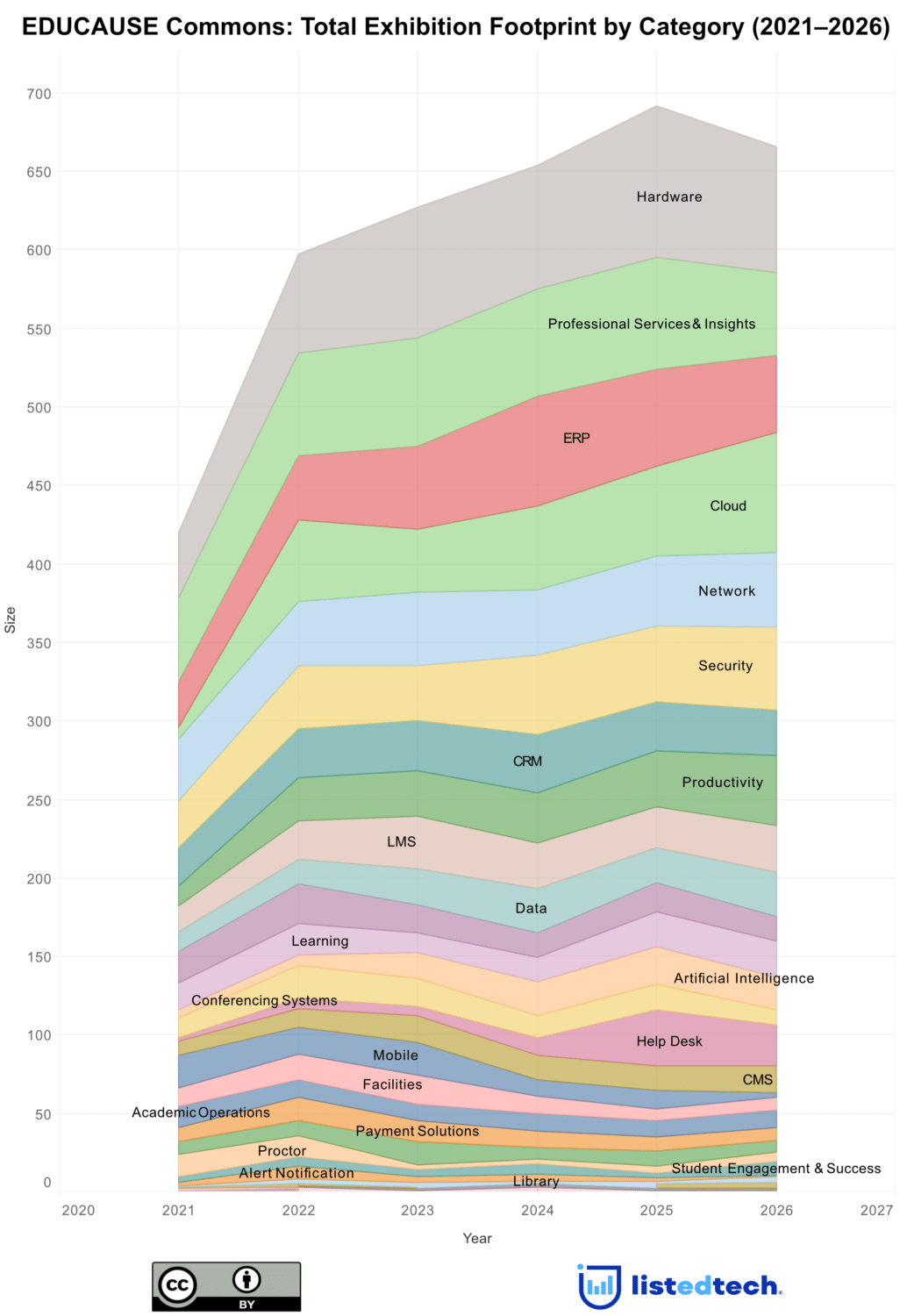
- Dominating the 2026 EDUCAUSE Commons with 40 exhibitors, Security reflects how institutions keep this category as their top priority in their academic and infrastructure operations. Institutional technology environments expand to include more cloud services, connected devices, and sensitive data, which explain why security remains among institutional priorities since 2021.
- Expanding substantially from just six in 2021 to reflect a major shift in institutional strategy, Cloud is the second-largest category on the Commons this year. This growth closely overlaps with the modernization of core enterprise resource planning and data systems, as cloud migration increasingly drives institutional interoperability, scalability, and access to campus information.
- Hardware and Network remain prominent foundational categories on the floor, proving that the physical and technical foundations of campus technology continue to attract vital investment. Alongside cloud and security, these investments offer a balanced industry picture, demonstrating that institutions are actively sustaining the underlying networks, devices, and infrastructure required to power advanced software environments.
- Data has expanded from eight exhibitors in 2021 to 18 in 2026 and is becoming the vital connective infrastructure for the entire higher-education ecosystem, driven by its foundational role in supporting AI, cloud migration, ERP modernization, analytics, and security compliance.
- Core systems, like LMS and ERP, are deeply embedded in institutional operations, showing that fundamental software continues to anchor the EDUCAUSE floor. Their persistent presence provides essential context for newer innovations, as emerging technologies and AI features are predominantly integrated directly into these existing platforms rather than deployed as entirely separate environments.
AI Is Bigger Than Its Category
The formal Artificial Intelligence category contains eight exhibitors in the 2026 data. That number is meaningful, but it understates the presence of AI across the conference.
A broader keyword review of company names and product categories identifies 24 AI-related exhibitors. These include companies classified under Artificial Intelligence as well as companies whose names, descriptions, or offerings indicate an AI focus. Examples include BoodleBox, CampusMind, CollegeVine, GitLab, LogicMonitor, Answerr.ai, AristAI, LearnWise AI, Praxis AI, SchoolAI, and Concentric AI.
The formal category answers the question: How many companies are explicitly classified as Artificial Intelligence exhibitors? The broader review answers a different question: How widely is AI appearing across the EDUCAUSE Commons?
The second measure is arguably more useful to understand AI’s current role in higher education. Many companies and products now include a mention about AI on their website or in their product descriptions. Artificial Intelligence is being embedded into cybersecurity, productivity, student support, learning, analytics, and administrative products.
The 2026 data therefore suggest that AI is developing in two directions at once:
- A standalone category of dedicated AI vendors is emerging.
- AI, as an embedded capability, is spreading across established technology categories.
This is consistent with the broader evolution of higher education technology. Rather than replacing core systems, AI is increasingly being layered onto the platforms and workflows institutions already use.
Is the Agenda Following the Floor Plan?
This year, in addition to the EDUCAUSE Commons, we dived into the EDUCAUSE conference agenda. The objective is not to determine whether exhibitors influence the agenda, or whether agenda topics attract exhibitors. Instead, we wanted to identify whether the two datasets move together over time.
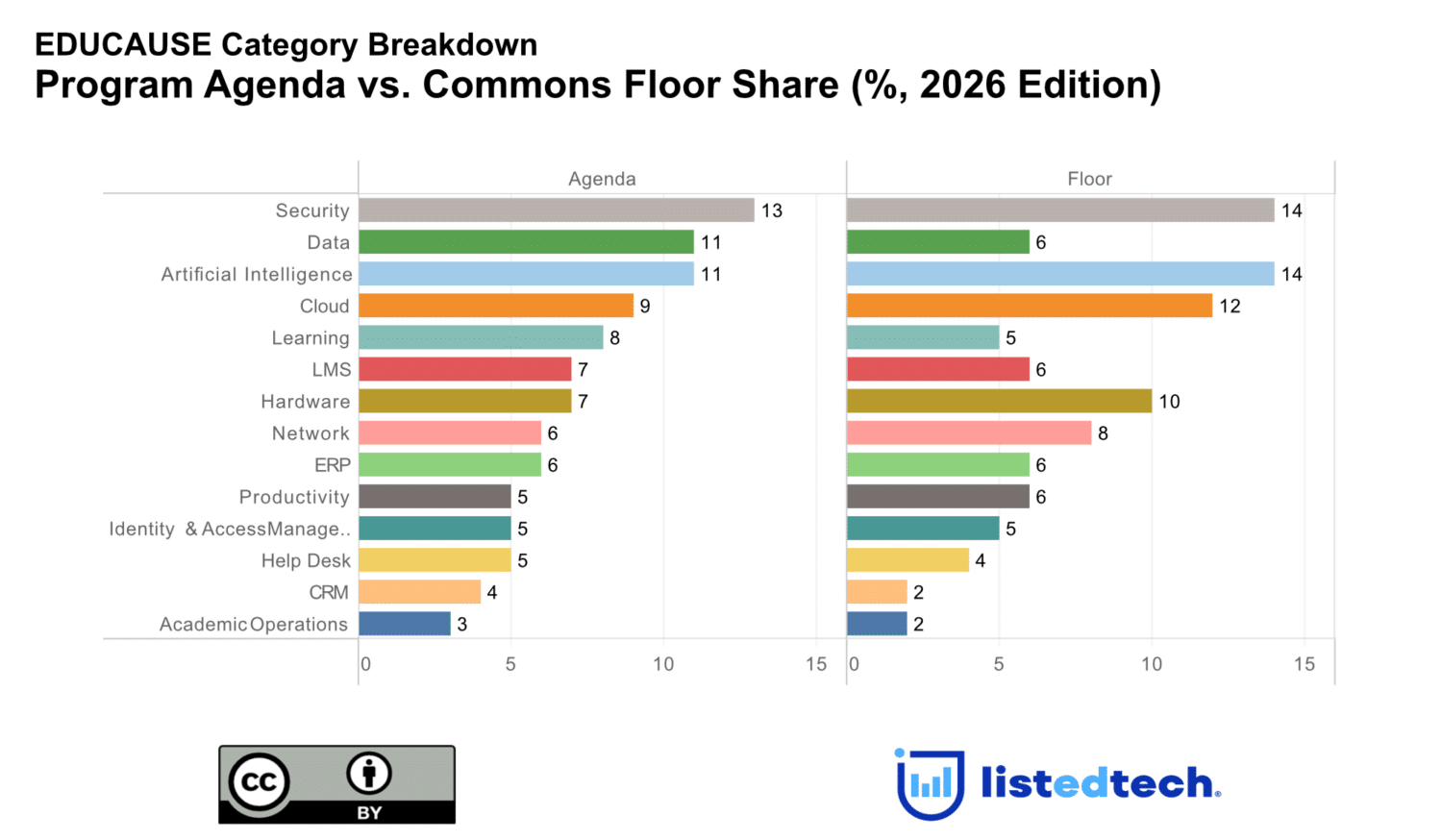
The Two Signals Generally Align
Across most of the categories included in the analysis, exhibitor counts and agenda-topic counts moved in the same direction. The strongest alignment appeared in Help Desk, Productivity, and Security. This means that categories gaining visibility on the exhibitor floor generally also gained visibility in the agenda over the six-year period.
The relationship was particularly strong for Help Desk and Productivity. Both categories expanded considerably on the exhibitor floor, while agenda attention also increased. This suggests a broader institutional focus on service delivery, workflow improvement, automation, user experience, and operational efficiency.
AI is especially notable. Its formal exhibitor category grew from two companies in 2021 to eight in 2026, while the directional agenda count increased from three to 22. This represents a much faster increase in agenda visibility than in the number of dedicated AI exhibitors. But, as we mentioned in the previous section, AI is present in many product categories as an embedded feature.
Not Every Category Moves Together
The aligned relationship is not universal. Some categories show weaker or negative alignment, including Identity & Access Management and CRM. This does not necessarily mean that those technologies are becoming less important. Category counts can be affected by mergers and acquisitions, product repositioning, conference participation, or the integration of capabilities into broader platforms.
CRM provides a useful example. Its exhibitor count declined between 2021 and 2026, while its directional agenda count increased. This could indicate that CRM-related conversations are increasingly being absorbed into broader discussions of student engagement, enrollment, advancement, customer experience, and institutional operations.
This is an important limitation of using categories as analytical units. A shrinking standalone category may reflect consolidation or integration rather than declining institutional demand.
What the Two Signals Reveal
Taken together, the exhibitor floor and the agenda point to several broad themes for higher education technology in 2026.
Modernization Is Still the Foundation
Cloud, ERP, Hardware, Network, Data, and Security remain prominent across the EDUCAUSE Commons. These categories represent the infrastructure and systems required for institutional modernization.
Higher education is not simply adding new tools. Institutions are also renewing core platforms, improving integration, strengthening security, and building the data foundations needed for more advanced services.
AI Is Moving from Novelty to Implementation
AI has substantial agenda visibility, but the Commons data show that it is not limited to dedicated AI companies. Its broader presence across the floor suggests that the market is moving from asking what AI is to asking how it can be implemented responsibly and effectively. We believe that the next phase of AI adoption will likely depend on integration with existing systems, governance, security, and practical institutional use cases.
Efficiency and Service Quality Matter
The rise of Help Desk and Productivity categories points to growing attention on operational effectiveness. As institutional technology environments become more complicated, universities need tools that make those environments easier to manage and easier to use.
Security Is Both a Technology Category and an Institutional Requirement
Security’s position as the largest 2026 exhibitor category demonstrates that it remains a foundational concern. It also connects directly to the growth of Cloud, Network, Data, Identity & Access Management, and AI. Becoming more interconnected, security systems become less of a standalone function and more of a requirement embedded across the entire technology environment, similar to what we observe with AI.
Conclusion
The analysis of the EDUCAUSE Commons remains a useful indicator of HigherEd technology priorities: Security, Cloud, Professional Services & Insights, Hardware to name the top ones. These categories describe a sector focused on modernization, infrastructure, resilience, integration, and operational effectiveness. At the same time, AI is becoming increasingly visible, through its growing presence across multiple established product categories.
The agenda adds a second dimension to this analysis. The available evidence shows that agenda attention and exhibitor presence generally move together. The topics gaining space on the floor are often the same topics gaining space in the program. That alignment suggests that EDUCAUSE is more than a list of products; it is capturing the challenges institutions are actively trying to solve.
As the 2026 conference approaches, the clearest signal is that institutions are working to connect traditional EdTech systems with emerging categories: securing cloud environments, modernizing core systems, improving data infrastructure, embedding AI into existing workflows, and making increasingly complex technology ecosystems more effective for the people who use them.