
Key Takeaways:
- Open Source Is Still Everywhere: 72% of HigherEd institutions in our global dataset use at least one open-source solution, with adoption rising to 80% in North America.
- The Business Model Shift: The narrative has shifted from “installing software” to consuming “managed services.” Cloud computing hasn’t killed open source; in many cases, it has simply changed how open-source software is delivered and monetized.
- Coexistence, Not Displacement: The future is not “open source vs. proprietary.” I think we are moving toward a much more mixed environment where open and proprietary technologies coexist.
Last week, I presented the webinar titled “The Future of Open Source in HigherEd: What the Data Tells Us” to the Apereo Foundation on the current state of open source in HigherEd. My starting premise was simple: In an era dominated by cloud-native SaaS, is open source still relevant?
I expected the answer to be nuanced. I didn’t expect the data to be this decisive.
As I prepared the presentation, I pulled data from ListEdTech covering nearly 19,000 HigherEd institutions around the world. Across 35 different product categories and over 2,800 products, I identified 86 major community-developed solutions. One stat really surprised me: 72% of HigherEd institutions in our worldwide dataset run at least one open-source solution.
Open Source Usage by Regions | |||
REGIONS | NUMBER OF INSTITUTIONS | … USING ≥ 1 OPEN SOURCE | PERCENTAGE |
WORLDWIDE | 18,972 | 13,610 | 72% |
AFRICA | 992 | 587 | 59% |
ASIA | 5,140 | 2,391 | 47% |
EUROPE | 3,289 | 2,553 | 78% |
LATIN AMERICA | 2,460 | 1,880 | 76% |
MIDDLE EAST | 828 | 510 | 62% |
NORTH AMERICA | 6,695 | 5,370 | 80% |
OCEANIA | 480 | 331 | 69% |
In North America, that number climbs to 80%. Clearly, open source isn’t just surviving. It’s already a significant part of day-to-day university technology. The real question is: are we watching open-source platforms win, lose, or simply change?
From Code to Commodity
For the past two decades, HigherEd technology has gone through a pretty significant change. We moved from software installed on campus to cloud-hosted SaaS. We saw Blackboard’s dominance challenged by Canvas and D2L, and we saw Moodle carve out a massive global footprint.
Against this backdrop, the easy assumption is that commercial SaaS is cannibalizing community software. The data suggests the opposite. The business model has matured.
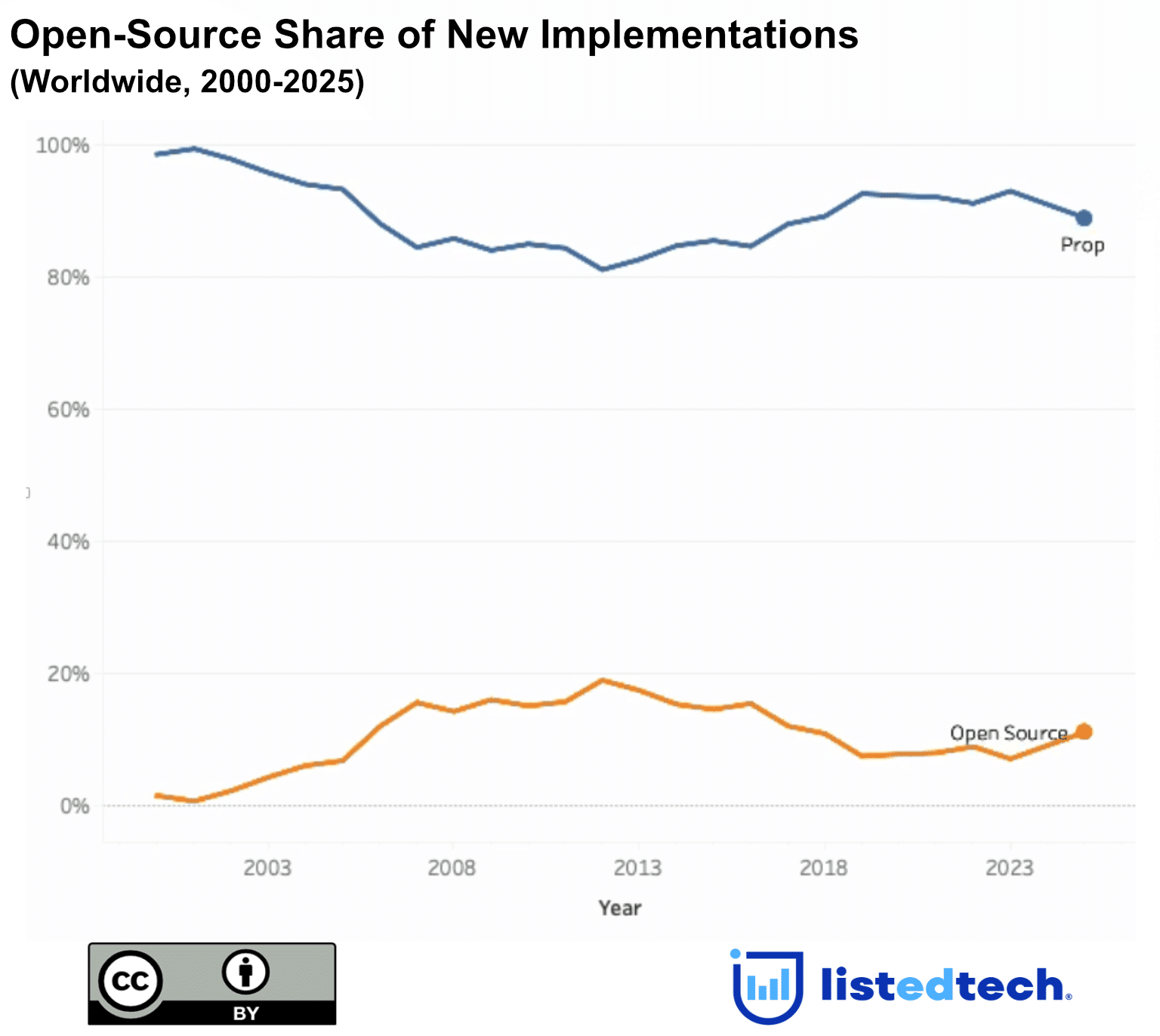
The traditional open-source model was relatively straightforward:
Download → Install → Modify → Maintain
An institution could download the software, install it on its own infrastructure, customize it and maintain it. That model still exists. But increasingly, community-built tech is becoming the foundation for something different:
Community → Platform → Managed Service → Enterprise Support → Commercial Ecosystem
Cloud didn’t kill open source; it made it scalable. Companies are now building sustainable commercial businesses around collaborative foundations by offering hosting, security, and enterprise-grade support. The value proposition has shifted from the code to the service. Open source is now “free” in licensing, but premium in implementation and management.
Open Source Is More Than Just Moodle
When we talk open source for education, the conversation often centers on Moodle. But Moodle is just the tip of the iceberg. Our data shows deep penetration across the stack:
- Digital Repositories
- Identity and Access Management
- Content Management Systems
- Library Systems
- and Learning Management Systems
In other words, community-driven solutions aren’t a niche in one product category. They are embedded throughout the technology stack of higher education.
How AI Fortifies the Open Argument
This was one of the areas I found most interesting. AI has introduced a new layer of complexity to the “open” debate. We are seeing a surge in open-weight models that institutions can run internally. This creates a strategic pivot for CIOs.
With traditional open source, we generally think about access to source code, the ability to modify it, and transparency around how the software is built. With AI models, we can have access to the model weights without having access to the training data, the complete build process or all of the components necessary to reproduce the model.
It isn’t just about picking the “best” AI model anymore. It’s about data sovereignty, privacy, and cost control. When a university asks, “Where do we want our AI to run, and who controls the data?”, they are fundamentally asking an open-source question.
Open Standards Matter Even More
One of the conclusions I came to while preparing the presentation is that we need to distinguish between open source and open standards. Open source gives you freedom over the software.
But I think open standards are becoming increasingly important. HigherEd institutions have accumulated hundreds of applications: LMS, SIS, Assessment Platforms, Analytics, Advising Systems to name some. In an AI world, we’re likely to have even more.
This may ultimately be one of the most important contributions of the collaborative movement. Not necessarily that every institution runs open-source software, but that institutions aren’t trapped inside proprietary ecosystems.
The Budget Question
There is another reason I think open source could become increasingly interesting to higher education: budgets. Universities are facing brutal budget pressures. Open source has always offered an attractive proposition:
Lower licensing costs + control + flexibility
The “Free Software” pitch of the 2000s doesn’t work in 2026. CIOs know that $0 software still requires investments in human resources, integration, security, training and governance.
So the real comparison isn’t: $0 open source vs. $100,000 proprietary software. It’s about Total Cost of Ownership (TCO). As institutions scrutinize SaaS spending, open source could become attractive again, not necessarily because it is free, but because it can provide another option for controlling technology costs.
The question becomes: What does this technology cost us to operate? rather than simply: What is the license fee? That’s a much more useful conversation for a CIO.
Security Changes the Conversation
Security remains the loudest argument for and against open source. The classic debate (“too many eyes on the code” vs. “too many eyes on the vulnerabilities”) is becoming outdated.
Transparency is valuable, but transparency by itself doesn’t create security. As software supply chains grow more complex, the burden of proof shifts. Regardless of the license, the market is favoring projects with mature governance and rigorous development practices. I believe that well-governed community-driven projects are now holding their own against proprietary enterprise software.
So, Is Open Source Winning?
After analyzing the data, I don’t see open source as winning or losing; I see an ecosystem undergoing a necessary evolution. The old model was about owning and operating the software. The emerging model is much broader.
The future of HigherEd EdTech won’t be a binary choice between proprietary and open source. It will be a hybrid environment where a university runs a proprietary SIS, an open-source IAM, and a mix of commercial and open AI models within a structured ecosystem with open standards and interoperability in mind.
And that may be the biggest surprise for me coming out of this analysis. Open source doesn’t need to replace proprietary software to be successful. It can coexist with it.
The Real Question for HigherEd
During the webinar with Apereo, I started the presentation asking: Is open source still relevant? After looking at the data, I’m not sure that’s the right question anymore. I think the better question is: What role will open source play in the next generation of higher education technology?
I don’t think the answer is that universities are going to suddenly abandon SaaS and return to installing everything themselves. That’s not realistic. Instead, I think we’re heading toward a world where open source becomes increasingly embedded in the technology ecosystem, sometimes visible to institutions and sometimes completely invisible.
The code may be open. The infrastructure may be commercial. The service may be SaaS. The AI model may be open-weight. And the systems may communicate through open standards. That doesn’t sound like the death of open source, it sounds like evolution. And based on what we’re seeing in the ListEdTech data, open source is already a very significant part of higher education technology. The interesting part is figuring out what happens next.
Note: We excluded Canvas as an open source product.