
Key Takeaways:
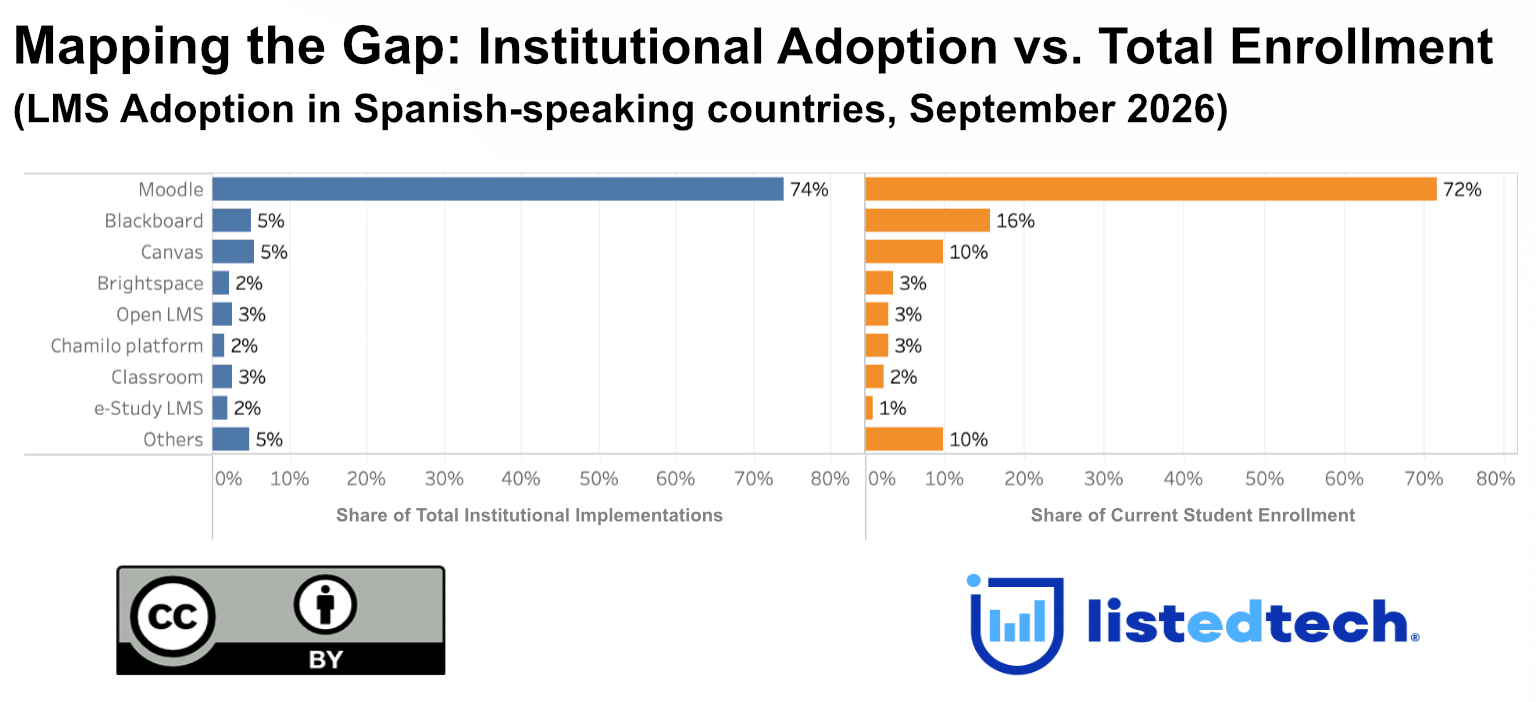
- The logo illusion: Moodle’s 74% institutional share creates a false monopoly, hiding the actual distribution of student scale and market value.
- Enrollment density: While Moodle leads in raw count, Blackboard (16%) and Canvas (10%) capture massive high-density university systems.
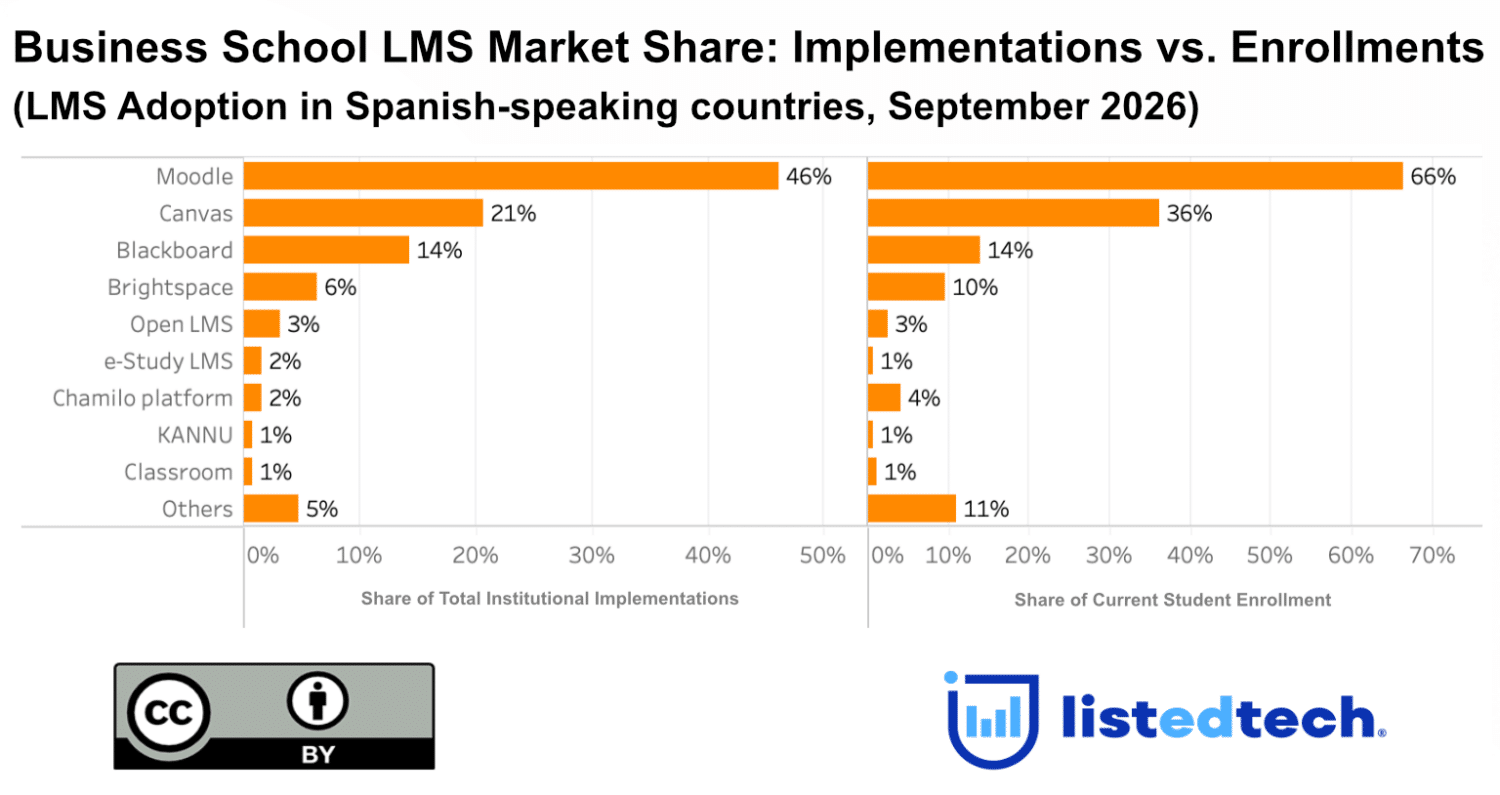
- Niche collapse: In competitive business schools, Moodle’s dominance drops to 46% as institutions turn to commercial alternatives.
A sales representative recently told me, “Moodle often looks like it dominates the market. But if you look closer, you can see where it doesn’t.” That statement didn’t just grab my attention; it confirmed a long-standing suspicion of mine that much of the industry is looking at the wrong map.
At ListEdTech, our baseline is simple: one institution equals one implementation. It’s a clean metric, but it’s also a lazy proxy for market health if you stop there. To get to the truth, we dove into the Spanish-speaking higher education LMS market (covering Spain and Latin America) analyzing a dataset of approximately 2,150 institutions and 24 million students. What we found is that while Moodle is ubiquitous, dominance is a matter of perspective, and for the strategic analyst, “simple” counting is the fastest way to miss the actual opportunity.
The Logo Illusion: Mapping Institutional Share
In the EdTech world, institutional share is the traditional default. It’s easy to understand because it’s a count of logos: how many flags has a vendor planted? When we look at this market through that specific lens, Moodle appears to have a total monopoly of quantity.
The institutional market shares are stark:
- Moodle: 74%
- Blackboard: 5%
- Canvas: 5%
- Open LMS: 3%
- Classroom: 3%
- Brightspace: 2%
- Chamilo: 2%
- e-Study LMS: 2%
- Others: 5%
When three out of every four institutions are running Moodle, the barrier to entry looks insurmountable for everyone else. You have a massive “long tail” of competitors, some of the biggest names in the world, fighting over 2% and 3% scraps. But this is the “logo illusion.” It suggests a market where the status quo is locked in stone. The reality is that this 74% share represents a monopoly of volume, but not necessarily a monopoly of value or strategic influence. To see where the money and the movement actually live, we have to pivot the data from the buildings to the people inside them.
Methodological Note: Total student enrollment percentages exceed 100% because institutions can implement multiple learning management systems concurrently. For instance, if a university runs both Moodle and Canvas, its entire student population is counted toward the enrollment totals of both platforms.
Counting Students vs. Counting Logos: The Enrollment Shift
Institutional share tells you how widespread a product is, but student enrollment share tells you about scale, usage intensity, and contract value. For any vendor, the goal isn’t just to be “everywhere”; it’s to be where the density is. When we shift the metric to enrollment, the “Moodle Hegemony” starts to show its first real cracks.
Look at the mathematical shift in the data:
- Moodle drops from 74% of institutions to 72% of student enrollment.
- Blackboard triples its influence, jumping from a 5% institutional share to a 16% share of students.
- Canvas doubles its footprint, moving from 5% of institutions to 10% of students.
That 2% drop for Moodle might look negligible, but when contrasted with Blackboard and Canvas “punching above their weight class,” it’s a massive signal. It proves that the commercial heavyweights are successfully securing the “big fish,” the massive university systems and high-density institutions. If you are a vendor, these enrollment numbers are your strategic goldmine; they reveal that while Moodle is the default for the average implementation, the largest student populations are increasingly open to alternatives. This brings us to the next layer of the onion: who exactly is choosing what?
Public Foundations and Private Diversification
To understand why Moodle is so deeply entrenched, you have to look at the divide between public and private institutions. In the Spanish-speaking market, Moodle is the public sector foundation. In many cases, this isn’t just about preference; it’s about government mandates, budget constraints, and a “standard” that has become hard to displace in bureaucratic environments.
However, the private sector is the true “canary in the coal mine” for commercial vendors. Among private institutions, Moodle’s share is lower, and the competitive landscape becomes significantly more diverse. Why? Because private institutions represent “active choice.” They operate under different procurement cycles and are often more agile in responding to student demands for modern UX and integrated support. For a CEO or a sales lead, the private market is the foothold where the “standard” can be challenged. This diversification is most visible in the sector that lives and dies by its competitive edge: the business school.
Business Schools: The Competitive Entry Point
If you want a leading indicator of where the market is headed, look at business schools. These are high-margin, high-competition environments. They compete internationally for students, they are early adopters of hybrid models, and they have the budget to prioritize premium features over “free” software.
In the business school niche, we don’t just see a shift; we see a break in Moodle’s dominance:
- Moodle: 46% (down from its 74% general share)
- Canvas: 21%
- Blackboard: 14%
- Brightspace: 6%
A drop from 74% to 46% shows a different market entirely. Business schools are the entry point because their requirements for graduate and professional education are more demanding. They value the advanced analytics, uptime, and support structures that commercial platforms provide. If you want to know where the “guard” is changing and where the most valuable contracts are moving, business schools are a great indicator.
Conclusion: The Market Share is Multidimensional
The lesson here is simple: Don’t just count logos. At ListEdTech, we’ve always maintained that the most valuable insights live in the “gap” between different data dimensions. To understand the true health of a market, you must look at:
- Size: Is the vendor winning small colleges or massive university systems?
- Geography: How do regional preferences in Spain differ from those in Latin America?
- Institution Type: Is the platform a public mandate or a private choice?
- Program Type: Does the LMS hold up in high-stakes environments like business schools?
Moodle’s 74% institutional share tells us it is the most widely adopted platform, but its 72% enrollment share and its 46% business school share tell us that the “Moodle-only” narrative is a trope, not a truth. Dominance is a matter of perspective. In this market, if you’re only counting logos, you’re not just missing the forest for the trees; you’re looking at the wrong forest entirely.