
Key Takeaways:
- Outcomes Over Features: Market success now hinges on supporting institutional goals rather than just expanding basic platform toolsets.
- Integrated Accessibility Workflows: Blackboard prioritizes automated accessibility tools to reduce manual burdens for instructors managing massive course portfolios.
- Authorship Verification Evolution: The platform shifts from punitive AI detection toward verifying authentic learning through student process metrics.
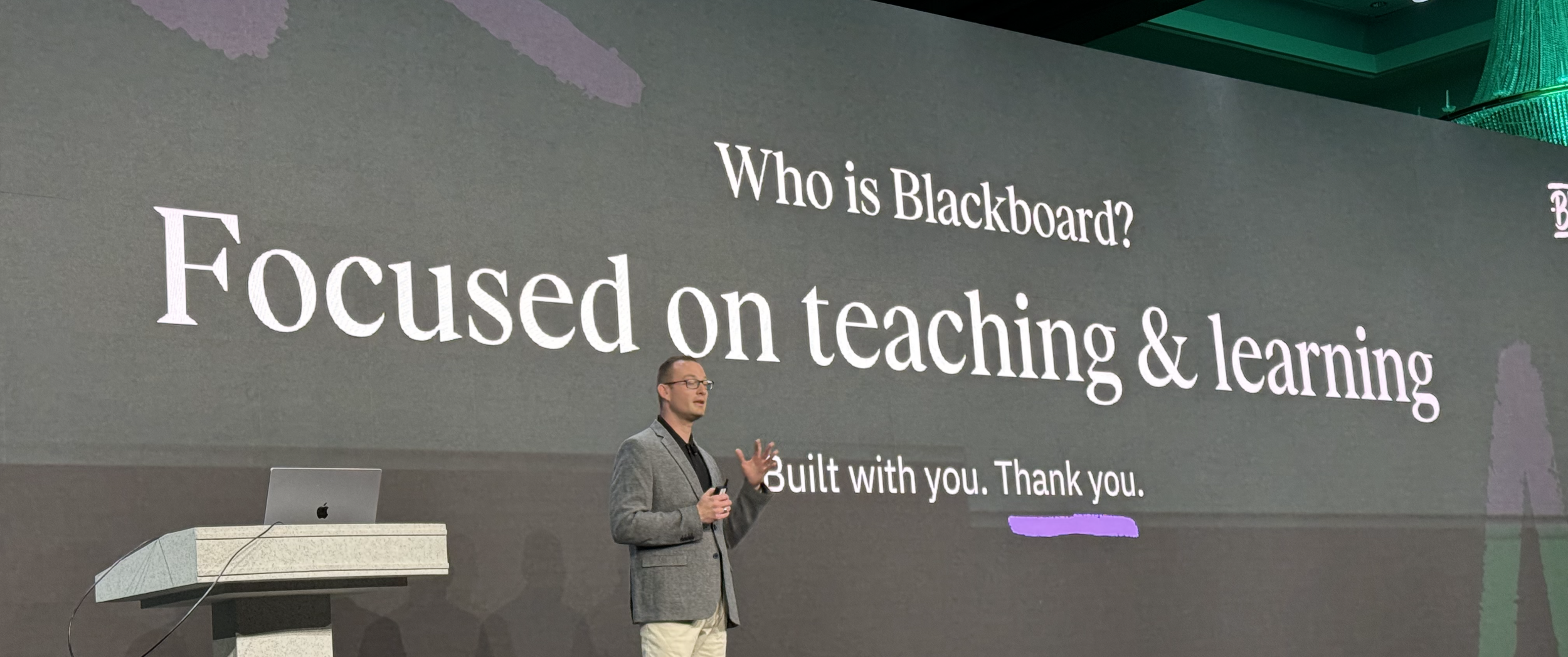
For years, the LMS market focused on feature parity; who has the best grade book or the most assessment tools? Those discussions are becoming secondary. At the recent Blackboard roadmap presentation during Building Blackboard Together 2026, the strategy centered on three measurable outcomes: Reach, Teach, and Demonstrate.
It’s a subtle but important shift. The focus is moving away from what an LMS can do and toward how institutions can support learners, improve teaching, and demonstrate learning outcomes.
Reach: Accessibility as a Workflow
Accessibility has long been an expectation, but Blackboard is making it a much more integrated part of course creation.
Blackboard is integrating accessibility directly into course creation. A standout development is Ally Auto Tagging for PDFs, which leverages AI to automatically generate document structure, including headings, tags, and reading order. This significantly reduces the manual burden for institutions managing thousands of legacy documents.
Additionally, the transition to the Blackboard Ultra experience continues at pace, with 86% of courses now migrated. Upcoming updates focus on modernizing the user experience through simplified navigation, full page views, and the technical infrastructure required for Dark Mode. These updates continue the effort to modernize the everyday experience for both students and instructors.
Teach: AI as a Pedagogical Assistant
Blackboard’s AI strategy emphasizes keeping the instructor in control. Their Trustworthy AI Framework ensures that customer data is not used to train third party models and that instructors remain responsible for final decisions.
Key AI powered enhancements include:
- AVA (AI Virtual Assistant): An embedded assistant that helps students locate information and query course content.
- AI Design Assistant: A tool for instructors to generate interactive learning activities, such as flashcards and personalized quizzes, based on their existing materials.
- Scholar by Blackboard: An AI powered interface that guides students toward curated institutional resources, positioning the LMS as a central hub for learning.
Rather than positioning AI as something that replaces teaching, Blackboard is presenting it as a tool that supports both instructors and students.
Demonstrate: From AI Detection to Authorship Verification
The most significant market shift is the move away from punitive AI detection toward learning verification.
Blackboard has integrated Cursive, a tool within the Blackboard portfolio designed for authorship verification. Unlike traditional AI classifiers that provide a probability score, Cursive analyzes the student’s typing patterns, revision history, and effort metrics. This provides instructors with a transparent view of the learning process rather than just the final submission.
By combining Cursive with pre submission rubric feedback, Blackboard is moving the industry toward a model where authentic learning is evidenced by the process, not just the product.
Institutional Planning: The Deadline for Blackboard Original
For institutions still using Blackboard Original, the transition timeline is becoming increasingly clear.
- December 31, 2026: Final day for active Original courses.
- January 1, 2027: Original courses become read-only as Blackboard completes its transition to Ultra.
Institutions that have delayed migration now have a firm deadline to plan against.
The ListEdTech Perspective
Blackboard’s recent updates highlight a broader maturation of the LMS market. Success is no longer defined by feature lists but by the ability to support measurable institutional outcomes. Accessibility, AI driven instruction, and authorship verification are now core infrastructure. For Blackboard, this strategy serves to solidify its position with larger institutions while providing a scalable, evidence based roadmap for the future of digital learning.
Disclosure: Blackboard covered travel expenses for the author to attend Building Blackboard Together 2026. This post reflects the independent perspective of ListEdTech. Blackboard had no editorial input, and this content was not shared with or reviewed by them prior to publication.