
Key Takeaways
- Permanent Operational Reality: Digital transformation has transitioned from a future goal to a constant, daily necessity for institutions.
- The Stability Paradox: AI remains secondary to foundational systems like IAM and ERP that ensure institutional reliability.
- Mandated Compliance Surge: Universities are prioritizing accessibility projects to meet the looming April 2026 legal regulatory deadline.
The trajectory of Higher Education technology has undergone a pivotal transformation over the last three years. In 2024, the sector was defined by post-pandemic stabilization. By 2025, that focus transitioned toward infrastructure maturity, with a heavy emphasis on cloud migration. As we enter 2026, digital transformation has moved from a theoretical future-state goal to a permanent operational reality.
Today’s IT leaders are managing a complex balancing act: maintaining robust foundations, such as Portals and Content Management Systems, while simultaneously architecting environments capable of supporting emerging smart, interoperable technologies. Within this landscape, Artificial Intelligence (AI) has moved beyond experimental pilots toward enterprise-wide strategic implementation. While AI occupies a massive amount of cultural mindshare, the data reveals a telling paradox: AI remains a secondary priority compared to the core connective tissue of the university. Systems facilitating identity management and ERP continue to lead the priority rankings. This underscores a critical insight: while innovation serves as the catalyst for growth, it cannot succeed without the stability of a high-functioning digital ecosystem.
Methodology
We utilize a rigorous data-driven methodology. We analyzed IT project information published on the websites of 55 universities across North America and Europe. Our analysis is unbiased and based exclusively on publicly available data, including the specific project nomenclature decided by the institutions.
To create our Top 10 list, we reviewed the content of 55 IT project webpages. We focused exclusively on centralized IT project pages, including:
- Michigan State University – MSU IT Projects
- The University of Texas at Arlington – Projects – Office of Information Technology
We did not include project-specific pages, such as:
In the past years, solution representatives also asked why certain products were excluded while their competitors are included. This is simply due to how universities choose to present their projects. Our analysis is always unbiased and based solely on the data available, including the project names decided by institutions.
The IT projects we identified are grouped into key themes. To qualify for this post, a theme must be mentioned on at least 10% of the institution websites (i.e. five universities). If a single institution lists multiple projects under a specific theme, we separate them using “//”.
List of IT Projects by Key Themes for 2026
Click on the down arrow sign to see the list of institutional project names.
Network Systems, including Telephony (33 universities)
- 5G and Wireless Service // Fiber Project // Automated Call Distribution (ACD) Project
- Campus Data Network Authentication Deployment
- Campus Network Refresh
- Campus Network UpgradeCampus Network Upgrade
- Campus Phone Migration
- Campus-wide WiFi
- Eduroam: External Wifi Access & Hubspot on Campus
- Enhance network management
- Expand Shared Directory and Endpoint Service Footprint
- Fiber Backbone Upgrades
- Implement Additional Network Ports // Upgrade RogueDetect
- Improving Wireless
- Network Access Control (NAC)
- Network core refresh
- Network Modernization
- Network Programme
- Network Services & Infrastructure Improvement
- Network Switches Upgrade
- Network transformation
- Network Upgrade (3x)
- New and stronger VPN solution for remote access to the network
- New Internet Platform
- Next Generation Network (3x)
- Upgrading the data network infrastructure and media technology for classroom and hybrid teaching
- WiFi 6 Network Coverage Expansion
- Wireless and wired upgrade
- Wireless Network Expansion
- Wireless Telecom
Identity and Access Management (27 universities)
- Access Request Re-Engineering
- Digital Identity and Access Management
- Endpoint Management (2x)
- Enhanced 2-Factor Authentication
- Faculty/Staff Windows Entra Migration Project
- GCP IAM Enhancements // MFA Alignment & Acceleration Project // Unizin Data Implementation // Microsoft Intune
- IAM Modernization Program (4x)
- IAM Requirements Gathering and Analysis
- Identity & Access Management Services Legacy Retirement
- Identity Governance
- Identity Management // Endpoint Management
- Improve User Experience and Access // Expand Shared Directory and Endpoint Service Footprint
- Integrated One-Card ID and Access System
- Microsoft Intune
- Mobile ID
- Move to CyberArk
- Multi-Factor Authentication Improvement (2x)
- TCard Upgrade
- TouchNet OneCard
- Virtual ID
- XID Conversions
- Zero Trust Network Access
Cloud Platforms and Storage, including Productivity Suites (21 universities)
- Audit Cloud Environment
- Box and O365 Account Deprovisioning Process// Legacy Accounts Migration to AWS // Storage Quota Implementations for MS365, Google, and Box
- Digital Storage Cost Reduction
- Fusion Transition to Cloud
- Google Storage Administration (3x)
- Google Workspace for Education Service Redesign
- Microsoft 365 Adoption (4x)
- Microsoft Licensing Automation // SPSC N190 Transition // Data Storage & Management // Sustainable Storage
- Microsoft Storage Changes
- New England Research Cloud
- Office 365 // G Suite // Google Drive
- Optimize the Workday Experience // Simplify Microsoft 365 Collaboration // Assess Storage Solutions // Implement Microsoft Email and Storage Changes
- Oracle Cloud ERP // EMR Solution // File Storage to M365
- Upgrade to Confluence Cloud
- Virtual Servers Deployment
- VMware Cloud Migration Project
Data Management (19 universities)
- Azure Arc Service PoC
- Communications Building Data Center Closure
- Data Drive Design - Innovation Network Project
- Data Governance and Management (2x)
- Data Inventory // Insights Data Warehouse
- Define institutional data strategy
- EDI Data
- Enterprise Oracle Exadata Migration
- Leverage cloud to modernise Data Centre facilities
- Orion to PeopleSoft Data Migration
- Revolutionize the Enterprise Data Ecosystem
- SAP HANA // Research Data Condo
- Secure Research Data and Compute (SRDC) platform // Data Center Evolution // Data Engineering & Integration
- SPSC N190 Transition // Academic Technology Tool data Integration into Snowflake Data Mart
- Student Data Warehouse (SDW)
- Training Management and Records System
- University Data Retention // File for Graduation Modeling Data Project
- Datahub API integration; HIPPO Database Replacement
Enterprise Resource Planning [ERP], including Procurement (19 universities)
- APC System application
- Delayed Pay Implementation
- E-Invoicing
- eProcurement System Implementation
- ERP Assessment
- ERP Changes
- Expense Management System
- HR Reports to tracking // Automation of labor data feed to Axiom // Workflow - Travel Authorization
- HR Systems Project
- Implementation of the new HR/Payroll and Financial System
- Integrated Renewal Program
- Integrated Renewal Program // Digital Payments Program
- Job ePAR - HR Forms Consolidation and Optimization
- NextGen/Workday Implement HCM
- ERP Modernization // Benefits Administration Platform Solution // PageUp Performance Management
- Provisioning Updates // Transact Integrated Payments Implementation
- Revenue for Digital Signage
- Time and Labor Project
- Upgrades to Oracle Fusion // New HR System // New Payroll System
Student Information Systems [SIS] (16 universities)
- Anthology SIS Implementation
- Applicant Management System // AMS Study Abroad Integration
- Banner 9 Self-Service (2x)
- Banner 9 Upgrade
- Changes to Banner
- Digitization of Registrar forms
- Ellucian Colleague Self-Service
- File for Graduation Modeling Data Project
- Integrated Renewal Program (Finance, HR, and Student Admin) // Technical Stabilization Framework for SIS
- Monthly OS Patching for Banner, Degree Works, online portal, and related systems
- SIS Replacement
- SIS Tuition Remission; SIS ISSO Terra Dotta Implementation
- Transition to Workday (2x)
Artificial Intelligence, including Chatbots (14 universities)
- AI Assistant
- AI Chatbot (2x)
- AI Chatbots for Open-Access Teaching // Google Gemini pilot // AI Website Launch
- AI Community of Interest
- AI Framework Initiative
- Embracing Artificial Intelligence (2x)
- Enterprise Generative AI Services and Support
- Generative AI
- Implementing Custom AI Chatbots (NebulaONE)
- Microsoft Sentinel and Security Copilot
- NebulaONE Pilot
- Private Generative AI Pilot
Help Desk Systems (14 universities)
- Case Management System
- Classroom Assistance Ticket System
- Enhance Service Management
- Explore OIT Notification and Aleting Solutions // Transition from Legacy Chat to Enhanced Chat
- IT Experience Transformation
- IT Support Virtual Agent Powered by ServiceNow
- New and Improved IT Self-Service Portal (ServiceNow 2.0)
- New Student Case Management System
- New Ticketing System/Asana Implementation
- ServiceLink Transformation
- TDX and PeopleSoft Asset Management Integration
- TeamDynamix Replacement
- TeamDynamix Ticketing // Topnet/Self-Service Navigation
- Unifying & Simplifying IT
Accessibility Software (13 universities)
- Accessibility Compliance
- Accessibility Plan
- Accessible Learning Object Design
- Assess Accessibility of Tools
- Digital Accessibility
- Digital Accessibility and Excellence
- Digital Accessibility Strategy
- Digital Accessibility Update
- Drupal PDF Accessibility Review
- EIR Accessibility Program
- Expand Digital Accessibility (2x)
- Public Website Accessibility Remediation
Learning Management Systems [LMS] (13 universities)
- Blackboard Learn Ultra
- Canvas
- Canvas Implementation // Blackboard Retirement
- Canvas Pilot
- Deliver Recommendations for LMS // Moodle as a replacement to Taskstream
- Evaluating the consolidation of LMS
- Experiential Learning (EL) Modules Project // Experiential Learning with Riipen Pilot // Active Learning Opportunities Through Virtual Lab Curricular Integration
- Goodbye Moodle, Hello Brightspace
- Improve Learning Technologies
- Learning Management System Review
- LMS to SIS Project
- New Content Experience
- New LMS for the Faculty of Medicine
Portals (13 universities)
- Analysis of the current portal solution
- Campus Portal Redesign
- Enhancing the portal (2x)
- Managing doctoral students in the portal
- Migration to SharePoint Online
- MyPortal
- New Community Platform
- New ITS Portal
- New Student App
- New Student Center
- Pathify Implementation
- Portal Mobile App
- Self-Service App
- Student Portal
Conferencing Systems (9 universities)
- Chat Integration with CXOne
- Conference/Classroom Technology Modernization
- Enterprise Video Platform
- File server to Teams Migration // Adoption of Kaltura Video
- Microsoft Teams Telephony project
- Teams Voice External Calling
- Upgrade LiveAlumni Service
- VMware Transition
- YuJa
Content Management Systems [CMS] (9 universities)
- CMS Catalog Connector // Website Review & Cleanup
- Comprehensive University Catalog
- Digital Signage
- Drupal 10 Upgrade (2x)
- Modernize Web Architecture
- MyOxford Student App; Improved Digital Communications Programme
- Sunset Blogs Service
- Transform the Web Experience
Customer Relationship Management [CRM], including Fundraising (9 universities)
- Core CRM Service
- Enterprise CRM // Advancement CRM // CRM Student Success
- Implement Contact Info App
- Learner Lifecycle CRM // Brand Indicators for Message Identification
- Marketing Technology Modernization
- Network Unified Communications
- Salesforce Implementation
- Student Experience Engagement and Communication Implementation
- Fundraising and Engagement Systems Replacement
Grant Systems (8 universities)
- Cayuse Implementation
- Integrate Streamlyne Electronic Research Administration Application with Banner
- ORSP Grant Management Project
- Research Management System
- Research Management System // Worktribe Research Ethics System
- SAP Grants Management
- Undergraduate Research Tracking
- Worktribe Research Administration
Library Information Systems (8 universities)
- BibliU BookStore Transition from Follett
- Deploy New Library System
- Institutional Repository/Digital Archive (TIND.io)
- Library Queries App
- Library Services Platform Upgrade
- Media Services Transfer
- New Library Management System
- One eText - Start Up Project
Business Intelligence [BI] (5 universities)
- Data Analytics Strategy
- Lucidchart
- Oracle BI reports migration
- Splunk Service Review // Technology Services BPI
- Tableau to Power BI Migration
Curriculum Management (5 universities)
- CourseLeaf
- Curriculum Planning Visualization Tool
- Degree and Program Offering by Modality // Smart Plan Degree Planner Implementation
- Transfer agreements and curriculum integration
- Workflow - Academic Program Review
Email Systems (5 universities)
- Email Security Improvements (2x)
- Events Team App (email automation)
- Implement Microsoft Email and Storage Changes
- UBC Emeriti Email Transition // Alumni Email Transition
IT Priorities Groupings and Explanations
1. Data and Storage: Cloud Platforms and Storage, including Productivity Suites (21); Data Management (19)
Universities are investing in cloud platforms and cloud storage to ensure that students and employees alike can work efficiently within a secure environment. Cloud storage projects are also linked to data management strategies to organize, secure, and utilize data assets. These projects align technical practices with broader business objectives, enhancing data quality to support competitive advantage. Compared to 2025, we have included Productivity Suites in this group since many projects combine data storage with productivity suites.
1. Identity Management: Access and Identity Management (27); Portals (13)
This category encompasses identity and access management (IAM), including multi-factor authentication. The number of IAM initiatives has increased from 18 last year to 27 this year, signalling a growing prioritization across institutions. These projects play a critical role in reducing exposure to cybersecurity threats and attack vectors.
3. Core Systems: Enterprise Resource Planning, including HR, Payroll and Procurement (19); Student Information Systems (16)
Student records, employee records, and invoicing, are vital IT systems needed to ensure smooth operations in higher education. With an average age of ten years, 25–40% of universities are actively replacing or modernizing their ERP and SIS platforms annually to ensure operational continuity.
4. Network and Security: Network Systems, including Telephony (33)
With identity theft and cyber-attacks on the rise, universities, like other businesses with a large technological footprint, must prevent these attacks. Network upgrades, software updates, and investments in security infrastructure are necessary to attain this goal. This year, fewer universities have specifically categorized projects under the “Security” label. However, security is increasingly embedded as an implicit component of all IT initiatives rather than a standalone silo.
5. Communication: Content Management Systems (9); Customer Relationship Management, including Fundraising (9); Email Systems (5)
Universities continue to make significant investments in content management systems (CMS) to strengthen and modernize communications with key stakeholders. In parallel, customer relationship management (CRM) initiatives—including fundraising platforms—remain high priorities, as both public and private institutions face tightening budgets and increased pressure to optimize revenue generation and engagement efforts.
5. Institutional Strategy: Accessibility Software (13); Business Intelligence (5); Curriculum Management (5)
As the April 2026 deadline for government website accessibility approaches, institutions have pivoted from viewing accessibility as an optional feature to a legal mandate. It is no longer a nice-to-have feature, it is a necessity. Placing Business Intelligence in this grouping shows the strategic use of data, including visual dashboards, in leadership decisions, trend forecasting, and reporting to boards.
7. Learning Environments: Learning Management Systems (13); Conferencing Systems (9)
A core mission of any university is to deliver a high-quality learning experience for students. Continued investment in learning management systems and online video infrastructure is therefore essential, as hybrid instruction and distance learning have become embedded components of everyday teaching and learning practices.
8. Research Support: Grant Management Systems (8); Library Information Systems (8)
Universities often rely on research grants to finance part of their operations. Committing to system improvements for grant management and library information systems ensure universities remain competitive and attractive to students and researchers alike.
9. Artificial Intelligence (14)
Universities use artificial intelligence to enhance efficiency, improve the student experience, and stay competitive in a rapidly evolving educational landscape. AI streamlines administrative processes, personalizes learning experiences, and provides round-the-clock support through virtual assistants. It also helps identify at-risk students, analyze institutional data for strategic decision-making, and drive innovation in research. In addition to operation efficiency, universities now implement AI solutions for students and staff. It seems that many universities have decided to take the “If you can’t beat ’em, join ’em” approach.
9. Help Desk Systems (14)
As universities move into more complex technology environments, offering more computerized solutions, IT departments need to invest in accompanying solutions for technical support. In our sample, projects are very diverse, although implementation of new help desk systems are more numerous.
IT Priorities Comparison Over Time
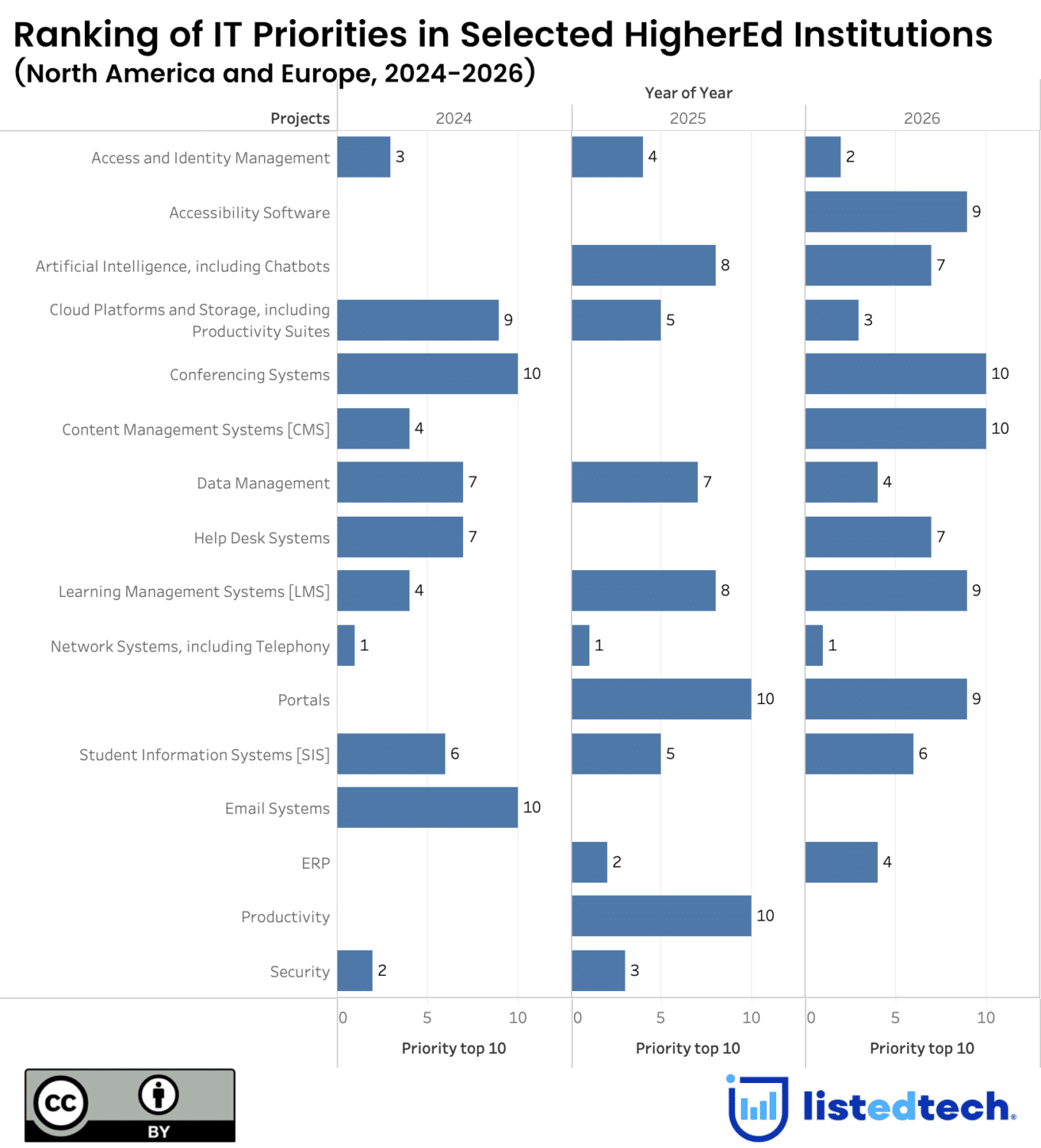
Note: Some categories have been combined over time. For an accurate depiction of the IT priorities for each year, we encourage you to read the previous posts on IT projects: Top IT Projects Shaping HigherEd in 2024 and IT Priorities for HigherEd Institutions in 2025.
How Does This Study Compare to the 2026 EDUCAUSE Top 10?
The EDUCAUSE Top 10 article outlines institutional priorities for many universities across North America. While earlier editions primarily focused on IT projects, they also incorporated broader business priorities not always directly tied to IT departments. This year is no exception. Nevertheless, the article remains a useful point of comparison for our analysis.
Furthermore, we have seen that priorities put forward by institutions sometimes matched their project roadmap.
Here is a side-by-side table of the EDUCAUSE Top 10 and ours:
| Educause | ListEdTech | Notes |
|---|---|---|
| 1. Collaborative Cybersecurity | 1. Identity Management and 4. Network and Security | As mentioned in our explanations above, (cyber)security is less and less part of IT project naming. However, we have notice in our analysis this year that (cybersecurity) is often mentioned in the description of multiple IT projects. |
| 2. The Human Edge of AI | 9. Artificial Intelligence | Among the IT projects related to artificial intelligence, some explicitly emphasize the human experience. Examples include initiatives such as AI Communities of Interest and Embracing Artificial Intelligence. |
| 3. Data Analytics for Operational and Financial Insights | 6. Institutional Strategy | Business intelligence transforms data analytics into actionable insights, empowering leaders to align technological resources with long-term institutional strategy and data-driven decision-making. |
| 4. Building a Data-Centric Culture Across the Institution | 1. Data and Storage | Modern cloud platforms and productivity suites integrate secure storage with collaborative workflows, fostering a data-centric culture that unlocks information as a vital strategic institutional asset. |
| 5. Knowledge Management for Safer AI | 6. Institutional Strategy | While this is not a direct comparison, elements of Educause’s Knowledge Management for AI resonate with the Institutional Strategy identified in our analysis. |
| 6. Measured Approaches to New Technologies | 3. Core Systems | This priority is related to the core business of institutions, and is linked to system replacement or modernization that are considered massive investments. |
| 7. Technology Literacy for the Future Workforce | 7. Learning Environments | This is related to learning environments although Educause's priority is more related to the content while our analysis focuses on system replacement or improvement. |
| 8. From Reactive to Proactive | 6. Institutional Strategy | This priority refers to the business intelligence component of the Institutional Strategy. |
| 9. AI-Enabled Efficiencies and Growth | 9. Artificial Intelligence | By implementing AI solutions, universities will allow their faculty and staff to reduce operational costs and streamline processes. |
| 10. Decision-Maker Data Skills and Literacy | 6. Institutional Strategy | The business intelligence projects will equip senior leaders with the skills to interpret and act on complex data. |
The comparison shows that institutional project roadmaps often diverge from the high-level business considerations identified by senior leadership. While leadership focuses on strategic concepts, the actual IT workload is dominated by foundational requirements like communication systems and research support, which are frequently omitted from high-level industry trend reports.
What Can We Learn From This Research?
As we navigate 2026, the higher education IT landscape has matured from the reactive, post-pandemic adjustments of 2024 into a state of permanent operational reality. While Artificial Intelligence commands significant attention for its ability to personalize the student journey and streamline workflows, it currently serves as a powerful secondary layer rather than the primary focus of institutional projects. The data points to a clear “stability paradox,” with universities prioritizing secure, mission-critical systems that form the connective infrastructure of the institution—most notably identity and access management (IAM), network systems, and core ERP/SIS platforms. This trend emphasizes that institutional innovation is entirely dependent on the reliability and security of the underlying digital ecosystem; innovation cannot succeed without a high-functioning, stable foundation.
The data-driven analysis reveals a distinct gap between high-level business considerations and the actual technical roadmaps currently being executed on campuses. While senior leadership often highlights strategic concepts like data-centric culture or technology literacy, the project lists show an intense focus on tangible infrastructure renewal and compliance-driven updates. We observe a significant surge in accessibility software projects as institutions race to meet the April 2026 legal deadline for government website accessibility. Furthermore, the analysis shows that universities are prioritizing the modernization of decade-old core systems and the integration of telephony into broader network infrastructure, moving away from viewing security as a standalone category and instead embedding it into every facet of the digital backbone.
.