Key Takeaways
- Cognition Over Networks: Platform power shifts from user scale to accumulated understanding of individuals.
- End-to-End Learning Tools: Platforms used across student life cycles become attractive infrastructure for higher education.
- Portable Understanding: Future advantage lies in cognition moving across systems, not institutional lock-in.
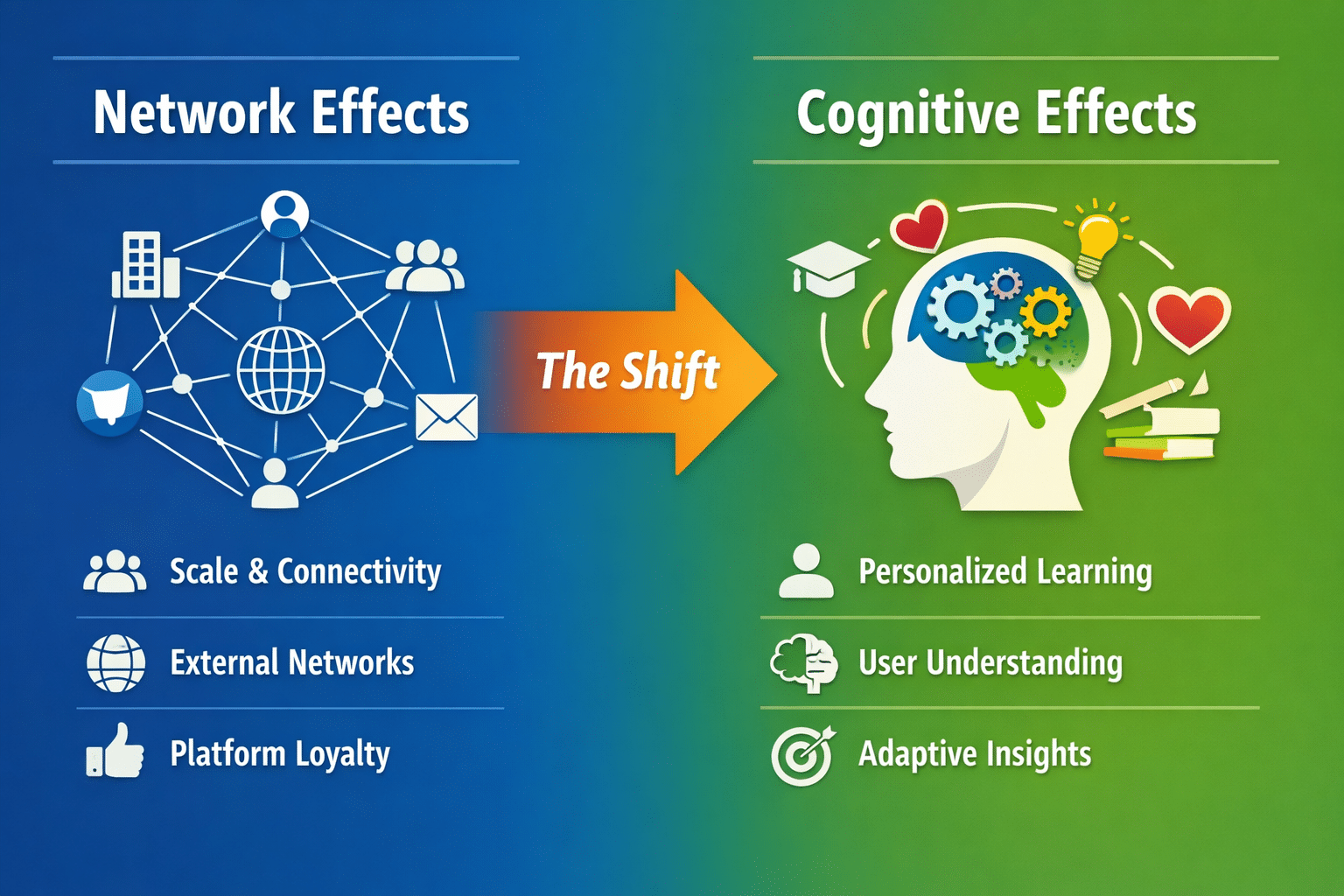
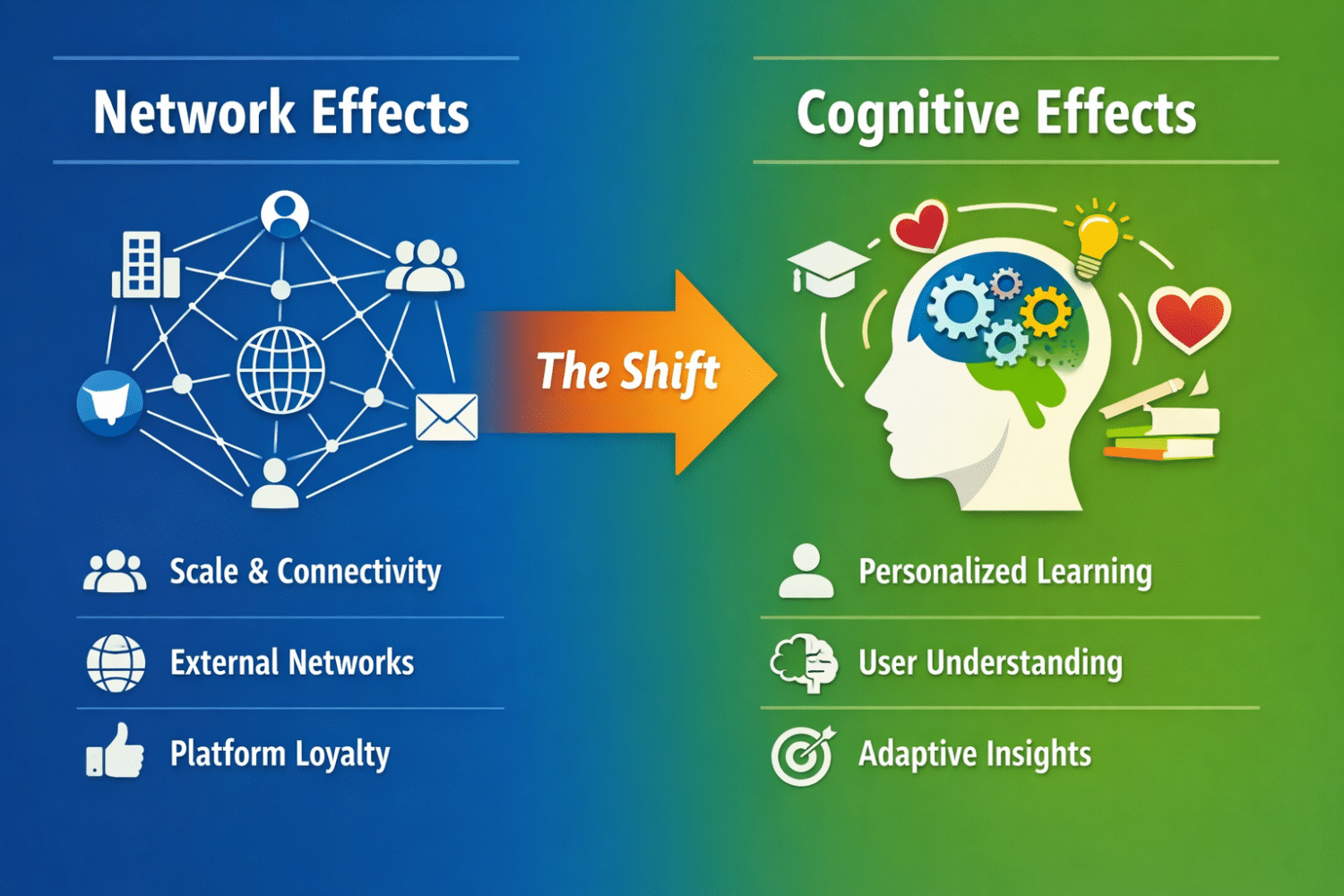
Thanks to Morgan at Phil Hill & Associates for surfacing a thoughtful piece by Kirsten Green at Forerunner on the shift from network effects to cognitive effects, and why this change may quietly rewrite the rules of platform dominance.
Her argument is simple but profound: the most powerful platforms going forward won’t just connect users; they’ll understand them.
And once you apply that lens to education, things get very interesting.
From Network Effects to Cognitive Effects: A Brief Recap
For years, technology dominance was built on network effects:
- Facebook mattered because everyone else was there
- LinkedIn mattered because your professional graph was there
- Uber mattered because more riders attracted more drivers, which attracted more riders.
But cognitive effects are different.
A cognitive platform becomes more valuable the more you use it—not because others do, but because it builds:
- long-term memory
- pattern recognition
- intent inference
- predictive intelligence
Leaving isn’t hard because your data is gone.
It’s hard because the understanding is gone.
Kirsten uses the example of switching from Spotify to Apple Music. Your playlists might transfer, but not the algorithm that knew:
- how you focus
- how you relax
- how your habits change over time
That loss is cognitive, not technical.
What Happens When This Hits Education?
Now imagine that same dynamic, not with music, but with learning.
The LMS That Knows How You Learn
Picture a student who uses the same learning platform throughout K–12.
Over time, that LMS learns:
- how quickly they absorb material
- where they struggle
- when they disengage
- what teaching methods work best for them
By the time that student applies to university, the LMS doesn’t just store coursework, it holds a learning model of the individual.
So here’s the uncomfortable question:
When students move to higher education, do they leave their LMS behind—or does the LMS follow them?
And if it can follow them:
- Does LMS familiarity become a selection criterion?
- Do institutions feel pressure to support dominant platforms?
- Does the institution become secondary to the student’s cognitive learning environment?
This is no longer theoretical.
K–12 Dominance Becomes a Cognitive Moat
In a cognitive world, dominating K–12 isn’t just about market share, it’s about starting the learning relationship earliest.
The more years a platform spends learning how a student learns, the stronger the moat becomes.
This starts to look less like traditional EdTech procurement and more like:
- Apple vs Android
- iOS vs Windows
You don’t switch casually. It’s not a question of ability; it’s that everything doesn’t feel quite right afterward.
And that raises questions education hasn’t had to confront yet:
- Will students prefer institutions that support their learning system?
- Will institutions have to subscribe to multiple LMS platforms to stay competitive?
- What happens to interoperability when cognition (not content) is the differentiator?
LMS Is Just the Beginning
Once you accept the cognitive effects thesis, it becomes obvious that LMS is only the first domino.
Student Information Systems (SIS)
In a cognitive model, SIS stops being a static system of record and becomes a predictive partner.
Instead of just tracking grades and enrollment, a cognitive SIS could:
- detect early signs of academic risk
- anticipate support needs
- identify patterns tied to persistence and completion
Much like wearables predicting health changes, a cognitive SIS could flag issues before students or advisors recognize them.
If that system follows a student across institutions, leaving it behind starts to feel like, borrowing Kirsten’s phrase, self-sabotage.
The Real Shift: Toward Portable Cognition
The biggest implication isn’t LMS vs SIS vs ERP.
It’s what happens between them.
Today, education systems are silos of intelligence:
- LMS knows how you learn
- SIS knows your academic record
- ERP knows your financial life
But cognitive effects point toward a future where memory becomes portable.
A Portable Cognition OS for education could allow:
- learning patterns from LMS to inform advising in SIS
- engagement signals to shape financial and retention strategies
- student context to persist across institutional boundaries
This creates a new kind of user contract—one based not on lock-in, but on earned trust.
Students remain because the system:
- sustains engagement
- minimizes friction
- builds understanding over time
Why This Matters Now
Education has spent years debating:
- data ownership
- interoperability
- privacy
- personalization
Cognitive effects force a harder question:
Who owns the understanding of the learner?
Because in the next era of EdTech, the most defensible platforms won’t be the ones with the biggest networks, but the ones that know each student best.
And once cognition compounds, switching costs stop being institutional. They become personal.