
As I’ve done in past years, I was invited to attend the Ellucian Live 2026 conference. This year, I was drawn to Ellucian’s evolving vision and roadmap, and I wanted to share a few observations.
For decades, higher education institutions have operated within a “maze” of complex, highly customized systems. While functional, these environments have also created significant operational friction.
Ellucian is now positioning a shift away from this fragmented model toward Ellucian Student, a unified platform designed to support the full student lifecycle.
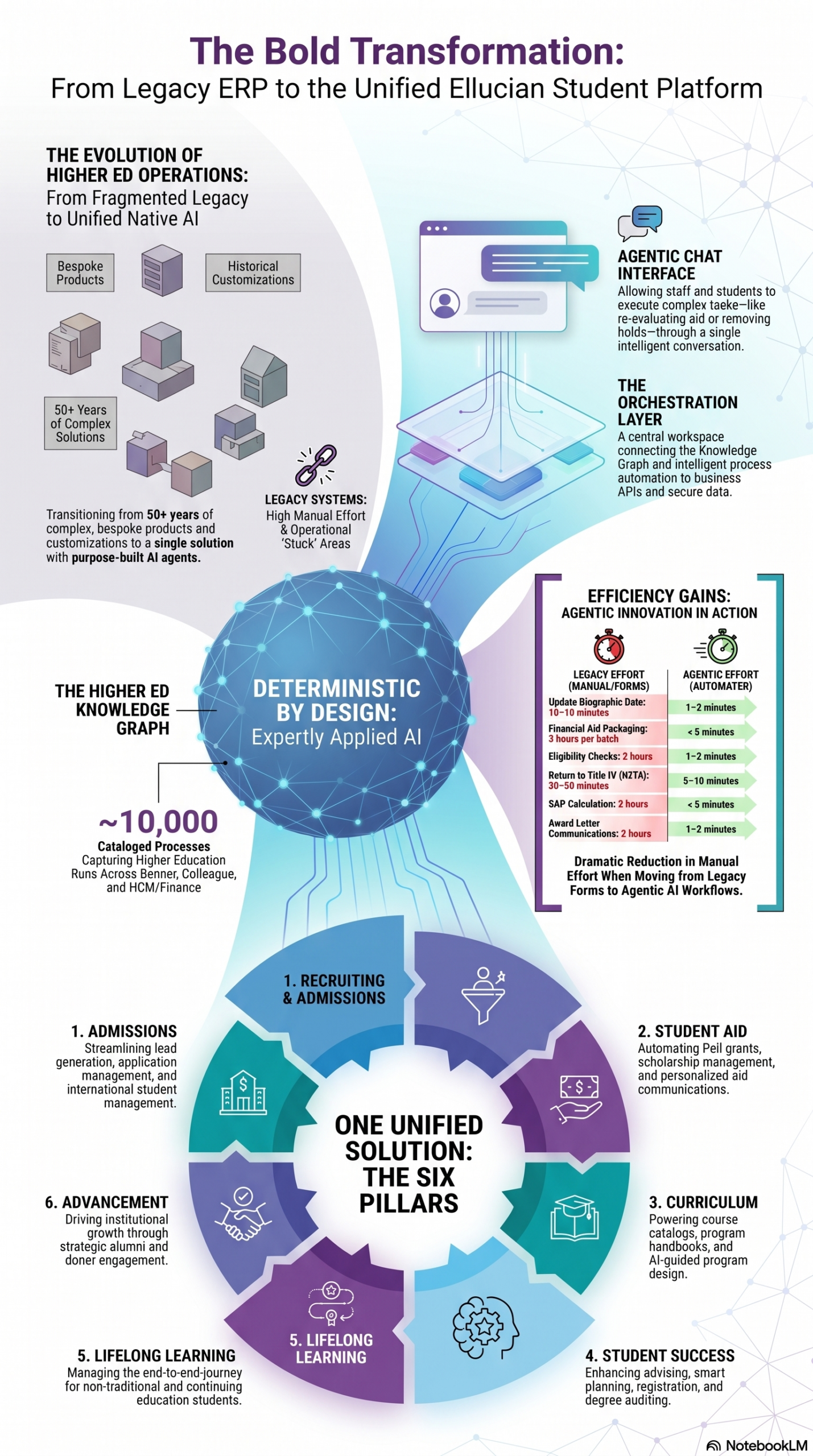
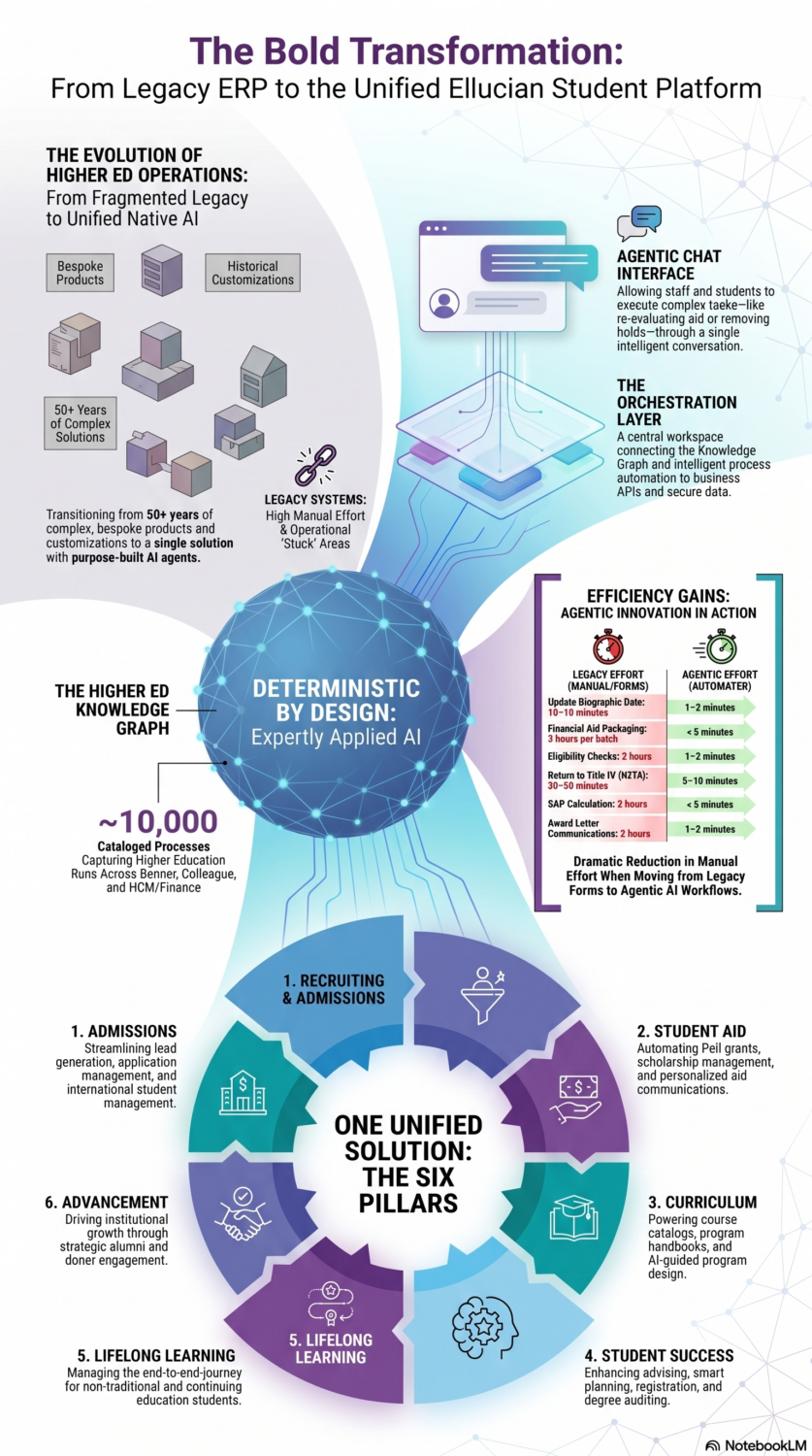
I asked Google NotebookLM to generate an image with my notes from their presentation.
A Shift Toward Unified Functional Value
This move is more than a rebrand. It reflects a broader change in how systems are structured, delivered, and consumed.
Rather than managing a wide set of disconnected tools, institutions are being guided toward a more integrated model across key functional areas:
- Recruiting & Admissions
- Student Aid
- Curriculum Management
- Student Success & Advising
- Lifelong Learning
- Advancement
HCM and Finance remain core components and continue to evolve alongside student-facing capabilities.
Deterministic AI: A Different Approach
One of the more notable themes is Ellucian’s focus on what they describe as “Deterministic by Design” AI.
Unlike probabilistic AI models that generate outputs based on patterns, this approach is grounded in a HigherEd-specific knowledge graph. According to Ellucian, this graph represents tens of thousands of institutional processes built over decades.
Their model follows a structured chain:
- Intent
- Process
- Execution
- Telemetry
The goal is to align AI outputs more closely with defined institutional rules and workflows, particularly for processes like degree audits, financial aid, and compliance-related tasks.
From Systems to “Agentic” Workflows
Another key concept introduced is the move toward agentic interaction models.
Instead of navigating systems directly, users interact through an orchestration layer that supports:
- Assistants for content generation and summarization
- Capabilities for targeted intelligence such as planning and retention insights
- Agents for workflow execution and delegation
This enables staff to initiate and complete tasks, such as resolving holds or processing changes, through conversational interfaces.
Ellucian also highlighted the idea of an Agent Marketplace, allowing third-party integrations to extend functionality, such as fraud detection.
Efficiency Gains With Context
Ellucian shared examples of significant efficiency improvements across common processes, such as financial aid packaging and eligibility checks.
While these are compelling, they will ultimately depend on implementation context, data quality, and institutional readiness, which tend to vary widely across institutions.
Modernization Without Full Replacement?
For Banner and Colleague SaaS customers, Ellucian is positioning this transition as a modernization path rather than a full reimplementation.
Using system scans and a reference architecture, they aim to map existing customizations into the new platform model.
This could be a meaningful differentiator if execution aligns with the vision.
The Broader Takeaway
The conversation in higher education is shifting. It is no longer just about cloud migration. It is about whether systems can become more adaptive, intelligent, and aligned with how institutions actually operate.
Agentic models are one possible direction. The key question will be how well they translate from roadmap to real-world impact.