
Key Takeaways:
- Anthology’s Ecosystem Vision: At its conference, Anthology highlighted its “Power of Together” vision, aiming to demonstrate how its products (LMS, SIS, CRM, etc.) work together to enhance institutional operations and personalized learning.
- Mixed Success: Analysis of over 2,375 institutions shows that while some Anthology products are well-integrated, such as the CRM and LMS, others, like the SIS, see less synergy. Institutions still often mix products from different vendors.
- Strategic Improvements Needed: To strengthen its ecosystem, Anthology should focus on clarifying its product benefits, rationalizing its portfolio, and better showcasing how its data platform and product bundles support cross-organizational processes
Many multi-product vendors argue that they offer product ecosystems, where their products interact and produce a value greater than the sum of their parts. They further say that, because of this interaction, one of their products should be more valuable to users if these users have already implemented another of their products in the ecosystem.
In its recent conference, Anthology refined its vision of its product ecosystem. Entitled “The Power of Together,” this vision intends to highlight how Anthology’s various products (LMS, SIS, CRM, etc.) come together to help institutional leaders unlock data silos, streamline operations, and personalize learning.
Anthology is banking on this refined vision resonating with institutional leaders. But what would Anthology have to do to make it work?
What is a Product Ecosystem?
As mentioned above, a product ecosystem is a collection of products offered by one vendor that interact, producing more significant effects when combined with products from another vendor. The rationale is that once customers enter the ecosystem, they are strongly inclined to buy more products to take advantage of additional synergies between them.
The best examples of a product ecosystem are Apple’s iPhone, Apple Watch, iPad, Air Pods, and MacBook products. Apple has taken great care to ensure it offers a clear set of products that work synergically, such as having universal access to files, transferring files, and synchronizing contacts and calendars. As a result, Apple users largely stay within its product ecosystem. For example, a 2023 survey showed that 79% of iPhone users own an Apple Watch, 64% own an iPad, 60% own Air Pods, and 42% own a MacBook.
However, in a recent post, we saw that the product ecosystem message has had mixed success with institutional leaders, many of whom still mix and match products from different vendors. Some vendors, such as Jenzabar and Populi, are succeeding in presenting a compelling picture to these leaders that the advantages of pairing their products outweigh any benefits of combining their products with those of other vendors. Yet others, such as Ellucian, find that their products can occur either alongside one of its products or products offered by another vendor.
What About Anthology’s Product Ecosystem Message Now?
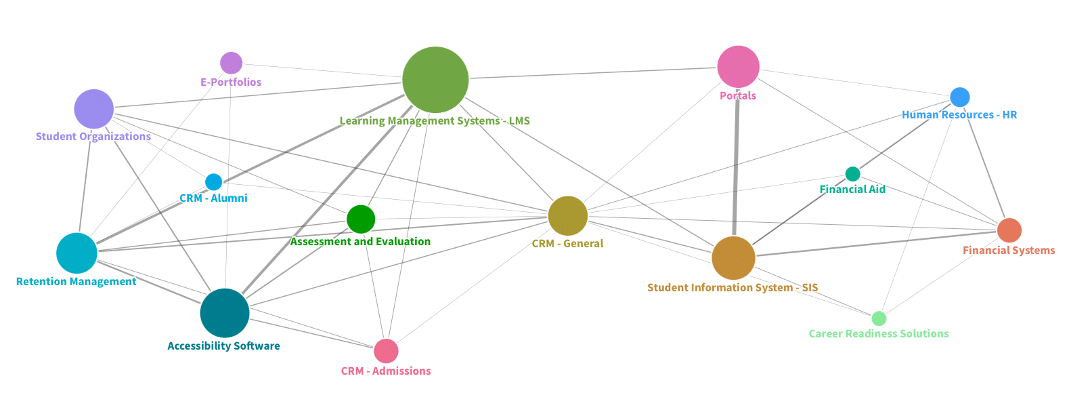
So, how successful is Anthology’s message of “togetherness” currently? To answer this question, we looked at implementation data from over 2,375 institutions that have implemented at least one Anthology product in any category with over one percent of product implementations. Figure 1 shows the output of our analysis, where the size of the bubbles indicates the number of implementations in that category, and the thickness of the lines reflects the strength of the association between those categories.
Source: ListEdTech
This figure indicates that Anthology’s current state of “togetherness” is mixed. Firstly, our analysis reveals that implementations of Anthology products broadly fall into two clusters: one where the learning management system and accessibility solutions are popular and another where student information systems and portals are popular. Secondly, as indicated by the number of lines extending from each product, implementations of Anthology’s CRM appear alongside the highest number of Anthology products (13), followed by the learning management system, which appears alongside nine. Lastly, while institutional leaders combine many Anthology products with others, the thickness of the lines suggests that more leaders combine their Anthology SIS with portals and their learning management systems with their accessibility solution.
This analysis suggests that, while many of its clients are bundling their products, Anthology still has a way to go before convincing institutional leaders of its benefits. Likewise, only two of its flagship products—the learning management system and the CRM—appear in most bundles with other products. In contrast, surprisingly, the product that serves as the hub of many institutional operations (the student information systems) appears in much fewer bundles.
What Should Anthology Do To Make Its Product Ecosystem Message Work?
One challenge with implementing a product ecosystem approach is making it easy for potential users to understand the complete set of products within the ecosystem and their functionality. At its conference, Anthology announced two decisions that will help them here. First, it announced that it would rationalize its product portfolio, reducing the number of products by eleven. Second, Anthology is structuring its product offering around three main pillars—Blackboard (LMS), Reach (CRM), and Student (SIS)—each of which will contain core and premium capabilities.
However, Anthology can take two actions to highlight its product ecosystem’s synergy and benefits. One, Anthology can better elevate its data platform and analytics product (Illuminate), highlighting how it ties together its bundles of products by sharing institution-wide data. Likewise, as Anthology’s products fall across several different organizational units in higher education (teaching and learning, administrative, etc.), Anthology can collect and express different use cases where bundles of products help with cross-organizational processes, such as assisting advisors by leveraging student achievement data from the LMS and other relevant data from the SIS.
Summary
The mixed nature of the current state of the Anthology product ecosystem should not be surprising. Anthology is a recent coming together of several companies, each with product portfolios covering different areas of higher education institutions (teaching and learning, administrative, career services, etc.). Likewise, creating a narrative that highlights the synergy between products is challenging, especially given the sheer number of seemingly overlapping products. However, Anthology has the components to deliver on its product ecosystem strategy, requiring no new product development, for example, to achieve it. It is now up to them to clarify this strategy and emphasize the critical synergy and benefits for it to be successful.