
The article is Cross-posted at Moran Technology Consulting
By: Charlie Moran, Sr. Partner & CEO, Moran Technology Consulting Justin Menard, CEO, ListEdTech

In a previous blog post, we discussed a multi-year downward trend of new Student Information System (SIS) implementations. Despite this downtrend, there are still many institutions upgrading and buying new SIS suites. In this post, we’ll take a look at data showing hosted versus on-premise implementations.
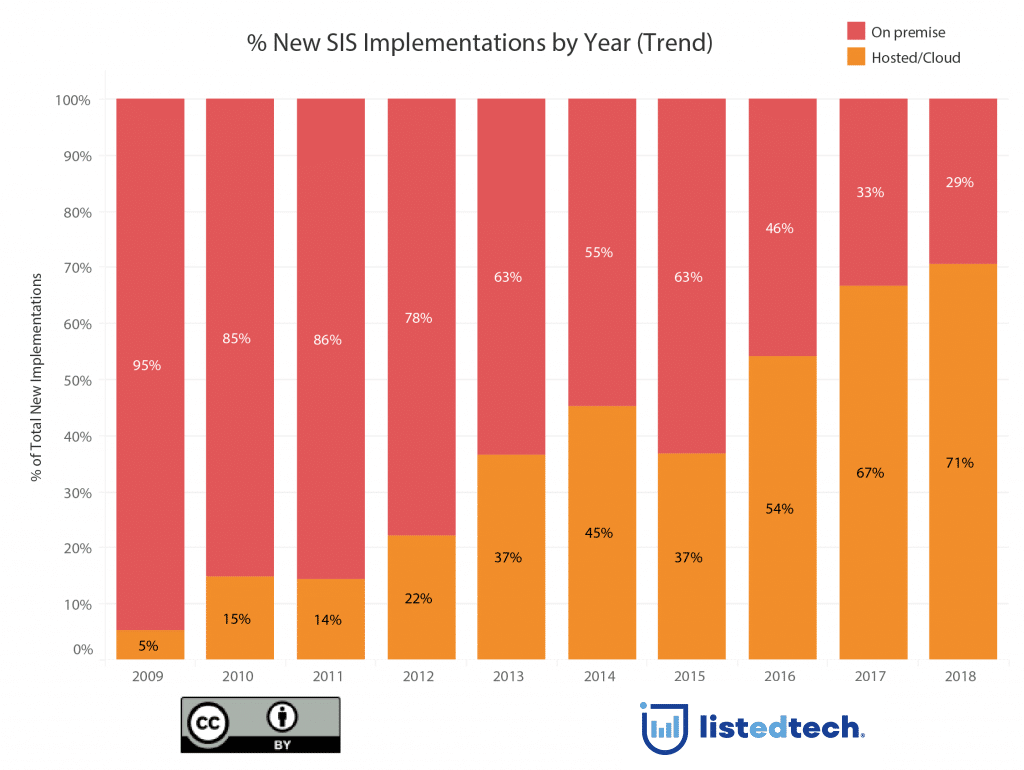
Among those institutions implementing new SIS applications, there is a clear, multi-year trend preferencing systems in a hosted/cloud environment.
We decided to look at the factors driving this trend. After analyzing the data, we came up with a set of major changes driving this trend.
Hosted/Cloud Drivers
In the 2006-2007 period, Google and Microsoft began to deploy large-scale, cloud-based, email / calendaring systems and allowed higher education to use them for ‘free’. This clearly demonstrated to even the biggest skeptics that the cloud concept was real, reliable and maybe affordable. (PS – Anyone who wants to argue about the word ‘free’, swing by our Educause booth and let’s grab a beer or soda and talk!)
New, more IT-savvy, user executives are starting to run our campuses and they are not willing to settle for “our systems can’t support answering your questions or delivering that service.” They have questions that need to be answered in a timely manner and new student services that they want to deploy quickly. They are looking for more flexible systems that can generally do what they want. They also need technology to help them more cost-effectively run their institutions. These create big problems for most legacy SIS and ERP systems.
Many of these legacy SIS systems were developed in the late 1980’s and early 1990’s when computers were very expensive, and people were relatively cheap. This resulted in software systems that required users to memorize many strange codes and screen field names to minimize computer processing costs. In those days, the phrase “user-friendly” meant that the user better be friendly to the software or it would ruin your day. Modern systems, being created in an era where computer processing was relatively inexpensive, moved to replace this coded and memorized information with understandable words and phrases, making it much easier for schools to support the software and train new users. Simplified usability is a major driver of new systems.
Vendors are moving their SIS solutions to off-premise environments that are reliable and potentially affordable. Some have chosen hybrid selling approaches where on-premise is still sold and supported, while hosted and cloud-based offerings are also available (e.g., Ellucian, Jenzabar). Others have created strong demand for products that are only available in the cloud (e.g., Workday, Oracle Cloud, Campus Management, Unit4). New SIS systems under development are all focused on a cloud-only implementation.
During the last recession (2008 to 2011-ish), many IT and functional staff were laid off and/or retired, and budgets did not allow them to be replaced. This created an environment where there was barely enough staff to maintain the current systems, let alone to take on new systems projects. This helped to drive the popularity of moving more work off-site to reduce campus IT staffing needs.
As budgets began to allow schools to hire again, they found that commercial firms were competing heavily for skilled IT staff, significantly raising the price to hire new IT staff and causing many IT positions to go unfilled.
Schools that were running the same SIS and ERP systems for longer than 10 years started doing financial analyses of their systems’ costs. Many discovered that they could pay both the annual subscription and implementations costs for newer cloud-based environments and break even on their migration in less than 10 years by ending high-cost legacy annual maintenance contracts and avoiding buying new data center equipment. I’ve seen a couple of schools where the break-even was less than 7 years.
Finally, in many cases, Workday has created an almost religious fervor from schools who want to use it even before they know if it will work for them. Kinda fascinating!
On-Premise Drivers
While we were reviewing these data, we thought we’d also discuss the major reasons that many institutions are still deploying SIS systems on premise.
Some schools have found that they can save significant money by deploying on-premise, when compared to cloud solutions. Cloud isn’t always cheaper, despite what some vendors have told us.
Some schools have access to financial capital, but limited access to operating budgets. Data center costs, like hardware and software initial license charges, are often capitalized, rather than expensed. SaaS cloud contracts are all paid from operating budgets and have to be expensed each year, not capitalized. Since SaaS contracts are often significantly higher than legacy maintenance costs, many schools simply cannot afford the increase in operating budget to pay for SaaS/cloud offerings. As one campus executive told me: “that increases our annual operating budget cost by $250,000. I would need to permanently lay off 4-5 staff to pay for it”. In some cases, this is a show stopper.
Some schools believe that they can’t get their users to accept an SIS ‘out-of-the-box’ – they will want to change it. A key theme of modern SaaS Cloud packages is that users cannot change them. They are highly flexible, more than most legacy systems, but you cannot customize them.
Stay tuned for future pieces as we start looking at who is buying and implementing SIS products these days. We’ll also explore the financial considerations that drive the trend of cloud-based computing in higher education.
Note: In an earlier blog (see “Some clouds aren’t clouds… but a truth is a truth…”), we decried vendor abuse of the term ‘cloud’. However, because of the difficulty in ascertaining whether an implementation is ‘hosted’ or ‘cloud’, we are forced to used vendor definitions of cloud for this analysis.
* = Here is a description of how we at ListEdTech collects our data.