
Educational technology conferences share the same aspects. Attendees hear ambitious keynote talks and flashy feature announcements, participate in deep-dive sessions and networking opportunities, and navigate huge hotels and long lines for coffee.
However, this year’s D2L Fusion conference—held in Toronto—was different in two ways. First, the organizers added an element of local charm to all of this, with performances by a Toronto-based theater group–the Stratford Festival–and a talk by Dr. Duke Redbird, an Elder from the Saugeen Ojibway Nation, on the shores of Lake Huron.
Second, underlying all the activities lay a developing and ambitious vision for D2L’s product direction: the role of the learning management system (LMS) in transforming teaching and learning. This week’s post will explore this vision and highlight an open question about its future success.
Transforming Teaching and Learning: Interconnected Technological Components
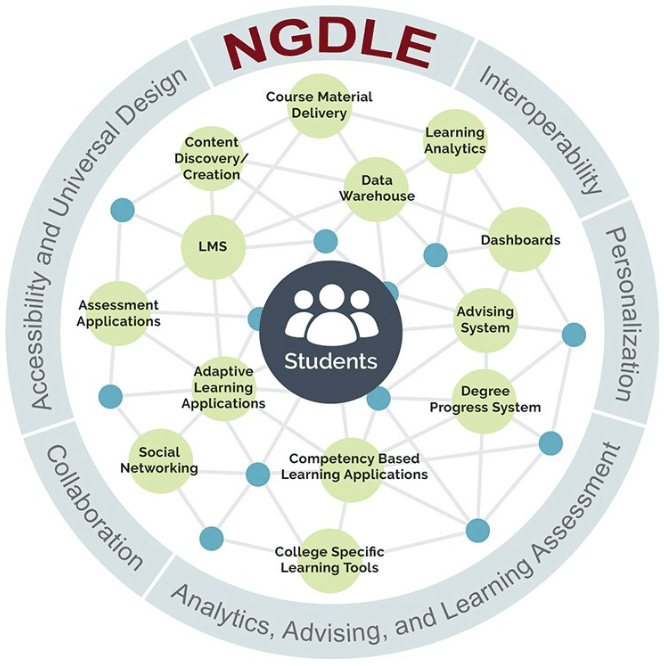
The prevalent view of transforming teaching and learning focuses on interconnected technological components, an example of which is the Next Generation Digital Learning Environment (NGDLE) (Figure 1). In this view, the ecosystem comprises interoperable solutions such as the LMS, advising systems, assessment applications, and learning analytics, which, along with principles (accessibility and universal design, etc.), power the transformation of teaching and learning.
Likewise, this view allows us to question whether the LMS is critical for transforming teaching and learning. For some, the LMS is crucial, given its role in providing operational support (course creation, for example) to the teaching and learning environment. For others like Duke University, the LMS is much less critical for their next-generation digital learning environments.
Transforming Teaching and Learning: Interconnected Ecosystem
Yet, throughout its conference and our conversations with senior leaders, an alternative picture of what an environment would need to be to transform teaching and learning and the role of the LMS in doing so came to light. John Baker, founder and CEO of D2L, signaled this picture in a chapter in Educause’s 2017 NGDLE report:
“An additional analogy can better describe the NGDLE: the LMS needs to be a central nervous system that connects the components (the bricks) in a unified learning ecosystem. And the NGDLE nervous system needs to understand, at a minimum, the learning outcomes, the learner assessment, the learner record, and how to launch the right learning moments.”
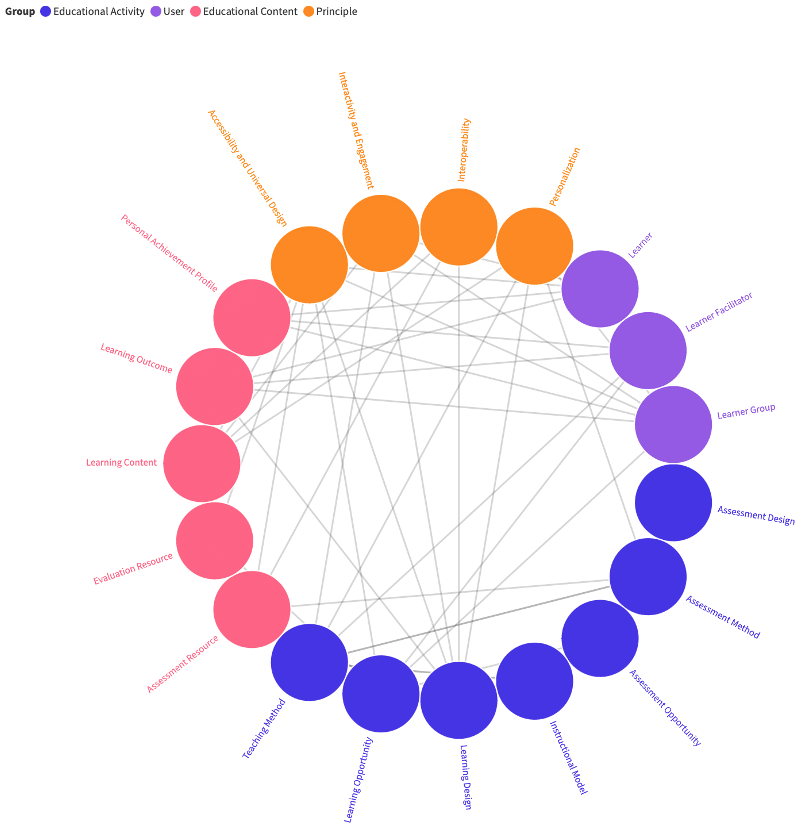
Viewing teaching and learning in this alternative way (Figure 2) helps us see it as an interconnected ecosystem and understand different aspects (educational activity, educational content, etc.), gaining greater insight into the complexity of transforming teaching and learning. Likewise, this view allows us to consider the effects of changes in characteristics such as educational modalities, student profiles, and types of digital content on teaching and learning and consider how we might address these changes in our transformation efforts.
Lastly, we can gain greater insight into how specific LMS functionality supports different ecosystem areas and assess whether it contributes to transformation efforts. For example, D2L’s announcement of Lumi, its artificial intelligence product, supports educational activity and content by enabling instructors to generate assessment questions, align discussions with course materials, and create content-based practice questions. Likewise, D2L’s Achievement+ informs how institutional leaders can track learner outcomes and inform improvements in teaching and learning. Finally, acquiring H5P Group aims to improve interactivity, personalization, and engagement across D2L’s offerings, helping D2L further support some transformative teaching and learning ecosystem principles.
Summary
While not specified at the conference, D2L believes this alternative view is more suited to transforming teaching and learning. Although not mutually exclusive to NGDLE, this view provides a different perspective on how we might target our transformation efforts and identify which product functionality helps these efforts along.
However, D2L faces some challenges. First, the market might see the two views as a distinction without a difference, i.e., viewing an NGDLE as a component-based environment provides no more insight into how we might transform teaching and learning than viewing it as composed of learning outcomes, learner assessments, learner records, etc. Likewise, D2L’s launching of new LMS features in component terms (improvements to product X or Y, for example) may make it more difficult for leaders to see the connection between these new features and the overall vision of transforming teaching and learning.
Therefore, while we think that D2L’s product vision, as we understand it, is attractive, it would be more explicit if it showed the connections between it and D2L’s product roadmap and launches. We do not doubt that the connections are there within D2L’s teams, but we think that making these connections explicit would better help D2L communicate how it sees the part its products might play in transforming teaching and learning.