
Key Takeaways:
- Founding: Founded in 1997 by Michael Chasen and Matthew Pittinsky, who later merged with Stephen Gilfus’s CourseInfo.
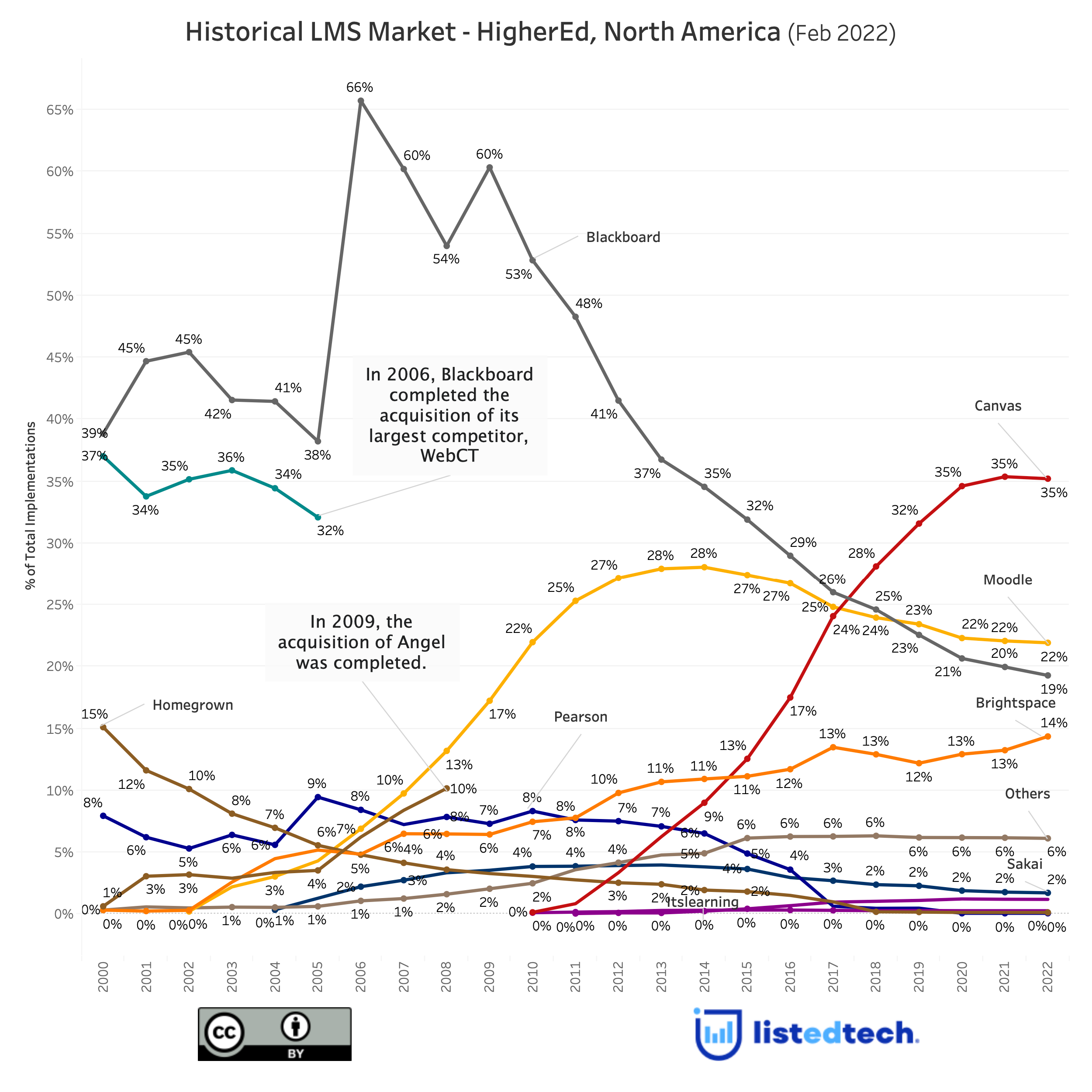
- Peak Market Dominance: Reached over 65% of U.S. college campuses by 2006 following its WebCT acquisition.
- Acquisition Spree: Invested over $500M in acquisitions between 2006 and 2012 (including ANGEL, Wimba, and Elluminate).
Before modern EdTech exploded, Blackboard was the original standard for digital learning, holding near-monopoly status across universities in the early 2000s. As shifting market dynamics and new competitors challenged its dominance, Blackboard made a strategic shift: diversifying its product portfolio to stabilize growth. Here is a breakdown of their story.
To understand how Blackboard started, we need to look at two companies: Blackboard itself and CourseInfo. The idea behind CourseInfo was to offer an interactive learning network to help teachers and professors adapt to the new reality of teaching at the time of the Internet. Within a few years, the company built a portfolio of 15 institutional clients including Cornell University, University of Pittsburgh and Yale Medical School.
In 1997, Michael Chasen and Matthew Pittinsky founded Blackboard with an innovative approach in mind: proposing an online learning solution and thinking through online learning standardization. About a year later, Chasen met with Stephen Gilfus, one of CourseInfo’s co-founders, and together they decided to join forces to form an improved version of Blackboard to attract new capital and scale the business.
They renamed the CourseInfo platform: Blackboard’s CourseInfo. At the time, the company offered a hosted version for teachers to try out for free. After only one year in business, its sales almost hit US$1 million. The newly formed company also created different versions of the original platform: Blackboard Classroom and Blackboard Campus.
By 2006, after the merger with WebCT, the platform was used in more than 65% of U.S. college campuses. In order to be implemented in many institutions across the United States, the company went through an important expansion funded through venture capital from a number of investors. At this time the company renamed its course management system to a new category: the “Learning Management Systems”.
Overseas expansion began in the early 2000s, growing to include Asia, Australia and Europe. In June 2004, Blackboard went public under the stock market ticker BBBB.
Mergers and Acquisitions
The Early Growth & WebCT Era (1997–2006)
Blackboard has acquired other companies to limit competition and expand into new business markets. The firm purchased Prometheus, a solution built by George Washington University, in 2002. Blackboard then acquired its main competitor, WebCT, in 2006, increasing its share of the higher education industry to between 65 and 75 percent. Over the years, Blackboard Xythos, Blackboard Connect, Blackboard Mobile, Blackboard Collaborate, and Blackboard Analytics were among the new products and acquisitions.
The Aggressive Acquisition Phase (2009–2016)
In 2009, the purchase of ANGEL Learning increased Blackboard’s client base to nearly 6,000. The corporation invested massively (more than $500 million) on acquisitions between 2006 and 2012. Between 2012 and 2016, the LMS company has also made acquisitions in other product categories such as collaboration tools, help desk, payment solutions, alert notifications, online program management, video conferencing, and business analytics. Blackboard’s acquisitions were not limited to the North American market; they also included enterprises from other continents. Outside of the United States, Moodlerooms Inc. and NetSpot are probably the most well-known purchased enterprises. These two companies became the basis of Blackboard’s Open Source Services division.
Even though most of the business done by Blackboard is in the U.S., it has been dominant on a global scale during the Moodlerooms years.
Complete List of Transactions Linked to Blackboard
| YEAR (most recent on top) | COMPANY NAME | PRODUCT CATEGORY | NOTES |
| 2026 | Blackboard | LMS | Following the Chapter 11 bankruptcy procedure, Blackboard is relaunching under its original name. |
| 2025 | Anthology | Multiple | The company filed for a pre-arranged Chapter 11 bankruptcy. |
| 2021 | Anthology | Multiple | Merger between Blackboard and Anthology |
| 2020 | Learning Technologies Group | LMS | Blackboard sold its open LMS products to LTG for USD32 million. |
| 2019 | Reverence Capital Partners | Payment Solutions | Blackboard sold Transact Campus to RCP. |
| 2016 | Fronteer Limited | LMS | |
| 2016 | Higher One | Payment Solutions | |
| 2016 | Sequoia Retail Systems | Payment Solutions | |
| 2015 | Blue Canary | Predictive Analytics | |
| 2015 | Nivel Siete | LMS | Acquisition of leading Moodle provider in Latin America by Blackboard |
| 2015 | X-Ray Analytics | Predictive Analytics | |
| 2015 | Remote-Learner UK | LMS (Open-Source) | |
| 2015 | Schoolwires | Website Solutions | |
| 2014 | ParentLink | Community Engagement | |
| 2014 | Requestec | Real-Time Communications | |
| 2014 | CardSmith | Campus Card Solutions | |
| 2014 | PerceptIS | Help Desk Solutions | |
| 2014 | MyEdu | Career Readiness Solutions | |
| 2012 | Moodlerooms | LMS | |
| 2012 | NetSpot | eLearning Technology Services | |
| 2011 | CerBibo Corporation | LMS | |
| 2011 | Edline | LMS | Merger between Blackboard and Edline |
| 2011 | Providence Equity Partners | Investment | Acquisition of Blackboard by Providence Equity Partners for USD1,640 million |
| 2011 | iStrategy Solutions | Business Intelligence and Analytics | Acquired by Blackboard for USD13 million |
| 2011 | Presidium Learning | Student Services Support | Acquired by Blackboard for USD53 million |
| 2010 | Wimba | LMS | Acquired by Blackboard for USD47 million |
| 2010 | Elluminate | LMS | Acquired by Blackboard for USD44 million |
| 2010 | Saf-T-Net | Alert Notification | Acquired by Blackboard for USD34 million |
| 2009 | Terriblyclever Design | Web Application Developper | |
| 2009 | ANGEL Learning | LMS | |
| 2008 | NTI Group | Alert Notification | Acquisition by Blackboard for USD166 million |
| 2006 | WebCT | LMS | Acquisition by Blackboard for USD178 million |
| 2002 | Prometheus | LMS |
Coming Back to its Core Business
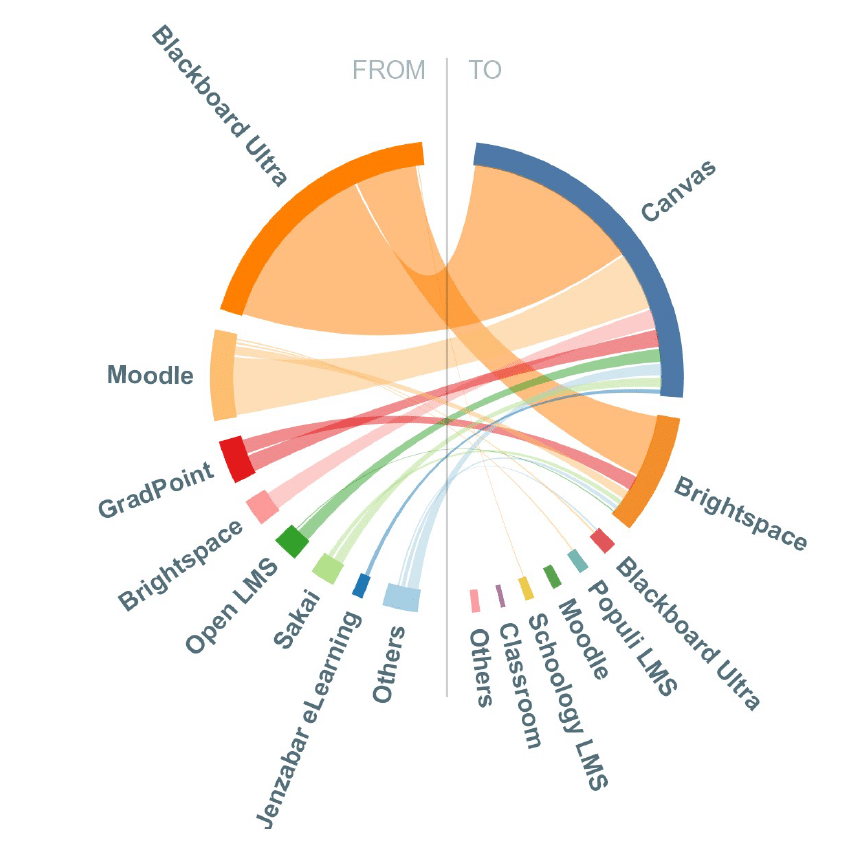
After the difficult passage through the loss of Moodle certification in 2018 that led to the sale of Moodlerooms, Blackboard was in financial difficulties and tried to improve its situation. In order to remain closer to its mission of providing education services to institutions, the company sold Transact to focus on learning solutions.
Despite having bought several LMS competitors, Blackboard struggled with maintaining its clients. At the time of the Transact’s sale, Blackboard was in high debt, an estimated USD 1.3 billion, based on e-Literate article. By selling Transact, they could cut this debt by half while “remain laser-focused on and continue to deliver market-leading innovation in its teaching and learning portfolio of solutions” as mentioned in the press release at the time. This transaction also helped Blackboard cut on massive expenses (office space, employees and R&D).
Anthology: A Brighter Future for Blackboard?
After several years of business difficulties and financial struggles, Blackboard may have found an ally in Anthology. Announced with pride by both companies in September 2021, the acquisition merger “will result in the end of Blackboard as a freestanding company, and could bring the end of its well-known, and sometimes controversial, brand” (Inside HigherEd). We also covered the merger in a separate post.
Will Anthology swallow Blackboard and rename its products with the Anthology branding? As of March 2022, the Blackboard website proudly mentions that it is now part of Anthology. On the Anthology website, it does not mention the Blackboard products.
The Restructuring and Blackboard’s Return
The merger promised a unified EdTech giant, but the reality of servicing an unsustainable debt load, compounded by integration friction and market competition, ultimately caught up with the company.
In September 2025, Anthology filed for Chapter 11 bankruptcy protection to execute a pre-arranged balance sheet restructuring and a breakup of its sprawling portfolio. Rather than leading to a shutdown or a permanent rebranding under Anthology, the restructuring resulted in a strategic pivot back to the company’s roots.
Through the Chapter 11 process, Anthology divested auxiliary segments. Its SIS/ERP and student success units were acquired by companies like Ellucian and Encoura, while wiping out its heavy debt burden. Emerging from the restructuring, the company successfully refocused around its core educational technology pillar, effectively returning to the market as a standalone entity centered once again on Blackboard and its flagship teaching and learning solutions (including Blackboard Learn and Anthology Ally). Matthew Pittinsky, the co-founder of Blackboard, is set to return as CEO in the upcoming future.
Nearly three decades after its founding in 1997, Blackboard has outlived its parent brand experiment, proving that while corporate structures and holding companies change, the Blackboard brand remains a persistent fixture of the higher education landscape.